Anoctamin 1, Calcium Activated Chloride Channel, Discovered On Gastrointestinal Stromal Tumors Protein 1, TAOS2, ORAOV2, TMEM16A, DOG1
Expression of DOG-1 protein is elevated in the gastrointestinal stromal tumors (GISTs), c-kit signaling-driven mesenchymal tumors of the GI tract. DOG-1 is rarely expressed in other soft tissue tumors, which, due to appearance, may be difficult to diagnose. Immunoreactivity for DOG-1 has been reported in 97.8 percent of scorable GISTs, including all c-kit negative GISTs. Overexpression of DOG-1 has been suggested to aid in the identification of GISTs, including Platelet-Derived Growth Factor Receptor Alpha mutants that fail to express c-kit antigen. The overall sensitivity of DOG1 and c-kit in GISTs is nearly identical: 94.4% vs. 94.7%.
200ug/ml of Ab Purified from Bioreactor Concentrate by Protein A/G. Prepared in 10mM PBS with 0.05% BSA & 0.05% azide. Also available WITHOUT BSA & azide at 1.0mg/ml.
Antibody Type:
Monoclonal Antibody
Application Notes:
Immunohistochemistry (Formalin-fixed) (1-2ug/ml for 30 minutes at RT)(Staining of formalin-fixed tissues requires heating tissue sections in 10mM Tris with 1mM EDTA, pH 9.0, for 45 min at 95C followed by cooling at RT for 20 minutes), Optimal dilution f
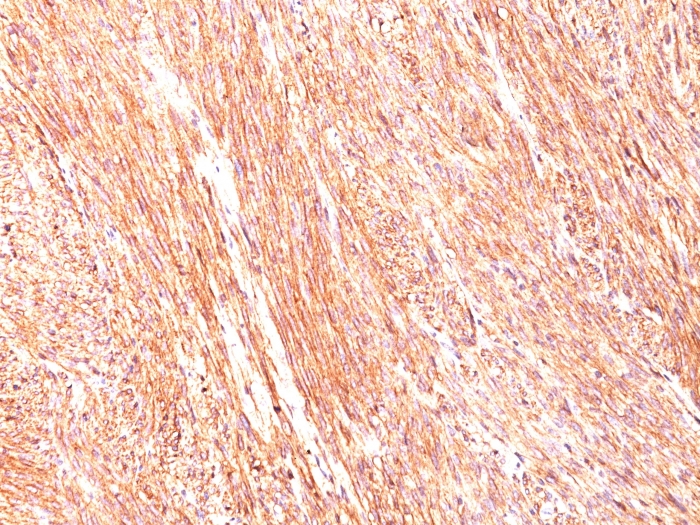
Formalin-fixed, paraffin-embedded human GIST stained with DOG-1 Mouse Monoclonal Antibody (DG1/447).
SDS-PAGE Analysis of Purified DOG-1 Mouse Monoclonal Antibody (DG1/447).
Formalin-fixed, paraffin-embedded human GIST stained with DOG-1 Mouse Monoclonal Antibody (DG1/447).
SDS-PAGE Analysis of Purified DOG-1 Mouse Monoclonal Antibody (DG1/447).
* VAT and and shipping costs not included. Errors and price changes excepted