

Antibody structure – what is a secondary antibody?
Antibody Structure
IgG as reference structure for immunoglobulins
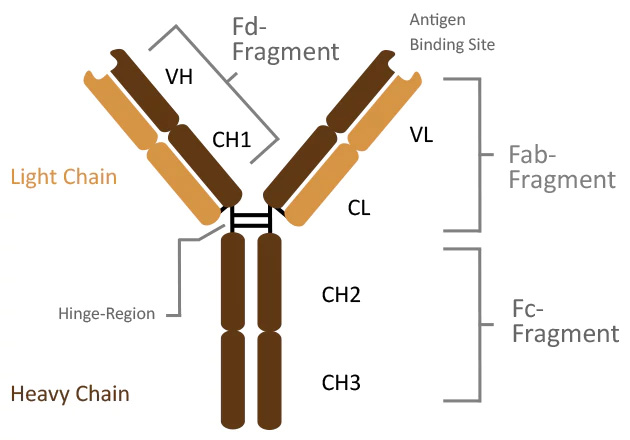
An immunoglobulin G (IgG) consists of two identical light (“L “ight) and heavy (“H “eavy) polypeptide chains connected by covalent disulfide bridges. The lower region is called the Fc fragment (fragment crystallizable). The two arms, each formed by the upper part of the H-chain and an L-chain, are called Fab fragment (antigen binding fragment). The light chains each consist of a variable domain (VL) and a constant domain (CL). The heavy chains, on the other hand, each have one variable and three constant domains. These are designated analogously as VH and CH1, CH2, CH3. |
Antibodystructure of Immunoglobulin G (IgG) |
Other immunoglobulin isotypes or classes
In mammals, five immunoglobulin classes, also known as isotypes, can be distinguished (IgG, IgA, IgM, IgE and IgD).
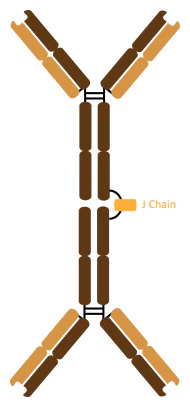
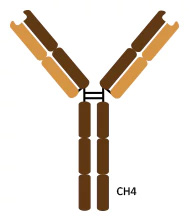
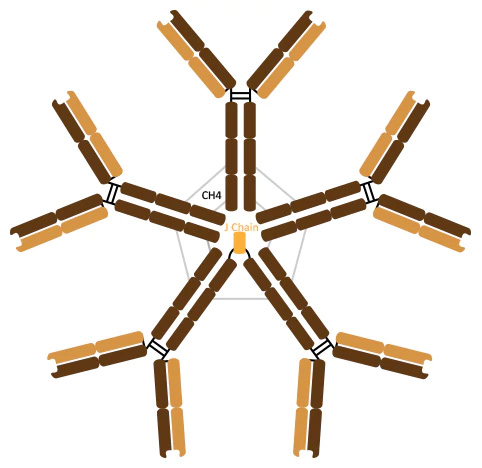
The differences between the isotypes lie within the H-chains. For example, IgM and IgE have an additional constant domain (CH4) in addition to differences in peptide sequence, compared to the three constant domains in IgG and IgA. Moreover, the latter is also expressed as a homodimer linked by a J-chain (Joining Peptide / Joining Chain). IgM, on the other hand, is formed as a pentamer and also contains a J-chain.
In addition, IgG and IgA are divided into four and two subclasses, respectively, which show fewer differences in the H-chain than is the case between the main classes.
| Antibodystructure of Immunoglobulin A (IgA) |
|
| Antibodystructure of Immunoglobulin E (IgE) |
|
| Antibodystructure of Immunoglobulin M (IgM) |
|
Variants of the light chain (κ and λ)
Differences between both the main classes and the subclasses occur exclusively in the range of H-chains. In the range of the L-chains there are two variants (κ and λ). The κ-L chain strongly predominates in the normal serum.
Structure of antibodies from camelids
|
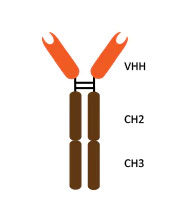
Camelids possess unique IgG subclasses among mammals. In the serum of these animals, in addition to the conventional IgG1 (classical structure), IgG2 and IgG3 are present. These have neither light chains nor CH1 domains in the heavy chains (Fig.2). The heavy chain antibodies have a small size, are extremely stable and show a high specificity and affinity to the respective antigen.
|
Alpaca IgG2 / IgG3 |
What are Secondary Antibodies?
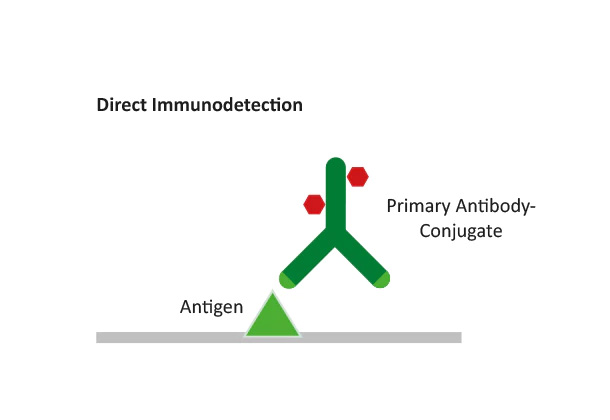
Direct antibody detection using a labelled primary antibody
The term secondary antibody is based on their functional property to recognize other antibodies as antigen. The antibodies recognized by a secondary antibody are called primary antibodies by analogy. Immunolabels with only one antibody are also called direct immunolabels. The primary antibody is usually bound directly to a reporter molecule. This can be a (fluorescent) dye or an enzyme that converts a substrate into a dye. Antibodies that are covalently linked to a reporter or marker are referred to as conjugates. |
Direct Immunodetection |
What are the advantages of using secondary antibodies over other direct labeled antibodies?
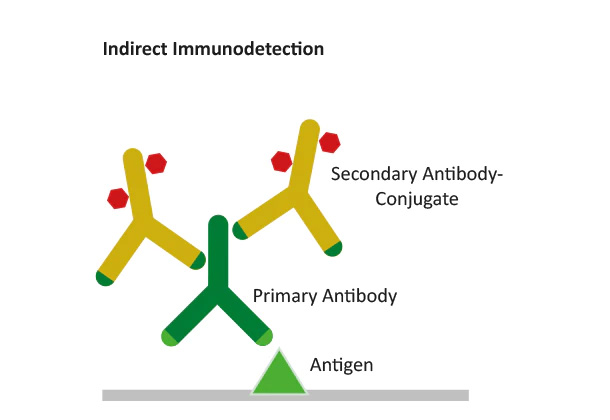
Indirect antibody detection using an unconjugated primary antibody and a labelled secondary antibody
In contrast, methods that use a secondary antibody to recognize another antibody are referred to as indirect labeling. Secondary antibodies are produced by immunizing animals with immunoglobulins or parts of immunoglobulins as antigen. The type of immunization and subsequent purification of the resulting antibodies is crucial for the specificity of the secondary antibodies. Compared to direct detection, the use of secondary antibodies has advantages. Since several secondary antibodies can usually bind to a primary antibody, there is signal amplification compared to direct methods. In addition, the use of secondary antibodies offers a high degree of flexibility, since not every primary antibody has to be directly labeled. However, especially in the case of indirect multiple labeling, the reagents must be carefully selected and coordinated to ensure reliable results. |
Indirect antibody detection |
The nomenclature of our secondary antibodies will help you to choose the right properties:

In our antibody search, you can select the properties you need by choosing from 6 properties in drop-down menus, allowing you to quickly and easily find the products best suited to your needs.
 |
 |