

TNXB Rabbit pAb, Unconjugated, Polyclonal
Artikelnummer:
ABB-A2535
- Bilder (1)
| Artikelname: | TNXB Rabbit pAb, Unconjugated, Polyclonal |
| Artikelnummer: | ABB-A2535 |
| Hersteller Artikelnummer: | A2535 |
| Alternativnummer: | ABB-A2535-20UL,ABB-A2535-100UL,ABB-A2535-1000UL,ABB-A2535-500UL |
| Hersteller: | ABclonal |
| Wirt: | Rabbit |
| Kategorie: | Antikörper |
| Applikation: | ELISA, WB |
| Spezies Reaktivität: | Human |
| Immunogen: | Recombinant protein (or fragment).This information is considered to be commercially sensitive. |
| Konjugation: | Unconjugated |
| Alternative Synonym: | XB, TNX, XBS, EDS3, HXBL, TENX, TN-X, VUR8, TNXB1, TNXB2, TNXBS, EDSCLL, EDSCLL1, TNXB |
| This gene encodes a member of the tenascin family of extracellular matrix glycoproteins. The tenascins have anti-adhesive effects, as opposed to fibronectin which is adhesive. This protein is thought to function in matrix maturation during wound healing, and its deficiency has been associated with the connective tissue disorder Ehlers-Danlos syndrome. This gene localizes to the major histocompatibility complex (MHC) class III region on chromosome 6. It is one of four genes in this cluster which have been duplicated. The duplicated copy of this gene is incomplete and is a pseudogene which is transcribed but does not encode a protein. The structure of this gene is unusual in that it overlaps the CREBL1 and CYP21A2 genes at its 5 and 3 ends, respectively. Multiple transcript variants encoding different isoforms have been found for this gene. |
| Klonalität: | Polyclonal |
| Molekulargewicht: | 458kDa |
| NCBI: | 7148 |
| UniProt: | P22105 |
| Reinheit: | Affinity purification |
| Sequenz: | TSFTTGGLRIPFPRDCGEEMQNGAGASRTSTIFLNGNRERPLNVFCDMETDGGGWLVFQRRMDGQTDFWRDWEDYAHGFGNISGEFWLGNEALHSLTQAGDYSMRVDLRAGDEAVFAQYDSFHVDSAAEYYRLHLEGYHGTAGDSMSYHSGSVFSARDRDPNSLLISCAVSYRGAWWYRNCHYANLNGLYGSTVDHQGVSWYHWKGFEFSVPFTEMKLRPRNFRSPAGGG |
| Target-Kategorie: | TNXB |
| Antibody Type: | Primary Antibody |
| Application Verdünnung: | WB,1:500 - 1:2000|ELISA,Recommended starting concentration is 1 µg/mL. Please optimize the concentration based on your specific assay requirements. |
| Anwendungsbeschreibung: | Cross-Reactivity: Mouse,Rat. ResearchArea: Signal Transduction,Cell Biology Developmental Biology,Cytoskeleton,Extracellular Matrix. Shipping: Ice Bag |
|
|
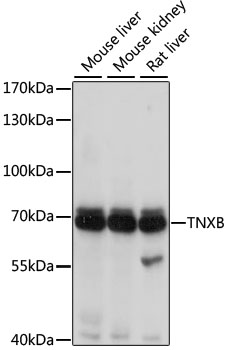
Western blot analysis of various lysates using TNXB Rabbit pAb (A2535) at 1:1000 dilution. Secondary antibody: HRP-conjugated Goat anti-Rabbit IgG (H+L) (AS014) at 1:10000 dilution. Lysates/proteins: 25µg per lane. Blocking buffer: 3% nonfat dry milk in TBST. Detection: ECL Basic Kit (RM00020). Exposure time: 1s. |
Produktgarantie und fachkundiger Support
