

PLG Rabbit pAb, Unconjugated, Polyclonal
Artikelnummer:
ABB-A3320
- Bilder (1)
| Artikelname: | PLG Rabbit pAb, Unconjugated, Polyclonal |
| Artikelnummer: | ABB-A3320 |
| Hersteller Artikelnummer: | A3320 |
| Alternativnummer: | ABB-A3320-100UL,ABB-A3320-20UL,ABB-A3320-1000UL,ABB-A3320-500UL |
| Hersteller: | ABclonal |
| Wirt: | Rabbit |
| Kategorie: | Antikörper |
| Applikation: | ELISA, WB |
| Spezies Reaktivität: | Human |
| Immunogen: | Recombinant protein (or fragment).This information is considered to be commercially sensitive. |
| Konjugation: | Unconjugated |
| Alternative Synonym: | HAE4, PLG |
| The plasminogen protein encoded by this gene is a serine protease that circulates in blood plasma as an inactive zymogen and is converted to the active protease, plasmin, by several plasminogen activators such as tissue plasminogen activator (tPA), urokinase plasminogen activator (uPA), kallikrein, and factor XII (Hageman factor). The conversion of plasminogen to plasmin involves the cleavage of the peptide bond between Arg-561 and Val-562. Plasmin cleavage also releases the angiostatin protein which inhibits angiogenesis. Plasmin degrades many blood plasma proteins, including fibrin-containing blood clots. As a serine protease, plasmin cleaves many products in addition to fibrin such as fibronectin, thrombospondin, laminin, and von Willebrand factor. Plasmin is inactivated by proteins such as alpha-2-macroglobulin and alpha-2-antiplasmin in addition to inhibitors of the various plasminogen activators. Plasminogen also interacts with plasminogen receptors which results in the retention of plasmin on cell surfaces and in plasmin-induced cell signaling. The localization of plasminogen on cell surfaces plays a role in the degradation of extracellular matrices, cell migration, inflamation, wound healing, oncogenesis, metastasis, myogenesis, muscle regeneration, neurite outgrowth, and fibrinolysis. This protein may also play a role in acute respiratory distress syndrome (ARDS) which, in part, is caused by enhanced clot formation and the suppression of fibrinolysis. Compared to other mammals, the cluster of plasminogen-like genes to which this gene belongs has been rearranged in catarrhine primates. |
| Klonalität: | Polyclonal |
| Molekulargewicht: | 91kDa |
| NCBI: | 5340 |
| UniProt: | P00747 |
| Reinheit: | Affinity purification |
| Sequenz: | EPLDDYVNTQGASLFSVTKKQLGAGSIEECAAKCEEDEEFTCRAFQYHSKEQQCVIMAENRKSSIIIRMRDVVLFEKKVYLSECKTGNGKNYRGTMSKTKNGITCQKWSSTSPHRPRFSPATHPSEGLEENYCRNPDNDPQGPWCYTTDPEKRYDYCDILECEEECMHCSGENYDGKISKTMSGLECQAWDSQSPHAHGYIPSKFPNKNLKKNYCRNPDRELRPWCFTTDPNKRWELCDIPRCTTPPPSSGPTYQ |
| Target-Kategorie: | PLG |
| Antibody Type: | Primary Antibody |
| Application Verdünnung: | WB,1:500 - 1:2000|ELISA,Recommended starting concentration is 1 µg/mL. Please optimize the concentration based on your specific assay requirements. |
| Anwendungsbeschreibung: | Cross-Reactivity: Human,Mouse,Rat. ResearchArea: Cancer,Invasion and Metastasis,Cell Biology Developmental Biology,Apoptosis,Ubiquitin,Cardiovascular,Angiogenesis,Blood. Shipping: Ice Bag |
|
|
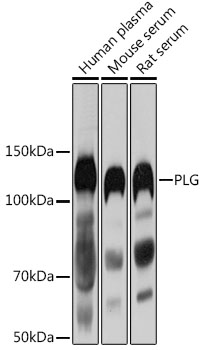
Western blot analysis of various lysates using PLG Rabbit pAb (A3320) at 1:1000 dilution. Secondary antibody: HRP-conjugated Goat anti-Rabbit IgG (H+L) (AS014) at 1:10000 dilution. Lysates/proteins: 25µg per lane. Blocking buffer: 3% nonfat dry milk in TBST. Detection: ECL Basic Kit (RM00020). Exposure time: 1s. |
Produktgarantie und fachkundiger Support
