

Phospho-Bcl-XL-S62 Rabbit pAb, Unconjugated
Artikelnummer:
ABB-AP0314
- Bilder (1)
| Artikelname: | Phospho-Bcl-XL-S62 Rabbit pAb, Unconjugated |
| Artikelnummer: | ABB-AP0314 |
| Hersteller Artikelnummer: | AP0314 |
| Alternativnummer: | ABB-AP0314-100UL, ABB-AP0314-20UL |
| Hersteller: | ABclonal |
| Wirt: | Rabbit |
| Kategorie: | Antikörper |
| Applikation: | IF, WB |
| Spezies Reaktivität: | Human |
| Immunogen: | Synthetic peptide. This information is considered to be commercially sensitive. |
| Konjugation: | Unconjugated |
| Alternative Synonym: | BCLX, BCL2L, Bcl-X, PPP1R52, BCL-XL/S, Phospho-Bcl-XL-S62 |
| The protein encoded by this gene belongs to the BCL-2 protein family. BCL-2 family members form hetero- or homodimers and act as anti- or pro-apoptotic regulators that are involved in a wide variety of cellular activities. The proteins encoded by this gene are located at the outer mitochondrial membrane, and have been shown to regulate outer mitochondrial membrane channel (VDAC) opening. VDAC regulates mitochondrial membrane potential, and thus controls the production of reactive oxygen species and release of cytochrome C by mitochondria, both of which are the potent inducers of cell apoptosis. Alternative splicing results in multiple transcript variants encoding two different isoforms. The longer isoform acts as an apoptotic inhibitor and the shorter isoform acts as an apoptotic activator. |
| Application Verdünnung: | WB,1:500 - 1:2000|IF/ICC,1:50 - 1:100 |
| Anwendungsbeschreibung: | Cross-Reactivity: Human,Mouse,Rat, ResearchArea: Cancer,Invasion and Metastasis,Cell Biology Developmental Biology,Apoptosis,Mitochondrial Control of Apoptosis,Inhibition of Apoptosis,Autophagy,Cell Cycle,Centrosome,Endocrine Metabolism,Immunology Inflammation,B Cell Receptor Signaling Pathway,Neuroscience,Neurodegenerative Diseases. |
|
|
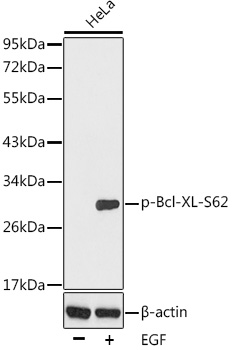
Western blot analysis of lysates from HeLa cells using Phospho-Bcl-XL-S62 Rabbit pAb (AP0314). Secondary antibody: HRP-conjugated Goat anti-Rabbit IgG (H+L) (AS014) at 1:10000 dilution. Lysates/proteins: 25µg per lane. Blocking buffer: 3% BSA. |
Produktgarantie und fachkundiger Support
