

Phospho-EIF4G1-S1108 Rabbit pAb, Unconjugated
Artikelnummer:
ABB-AP0796
- Bilder (1)
| Artikelname: | Phospho-EIF4G1-S1108 Rabbit pAb, Unconjugated |
| Artikelnummer: | ABB-AP0796 |
| Hersteller Artikelnummer: | AP0796 |
| Alternativnummer: | ABB-AP0796-20UL, ABB-AP0796-100UL |
| Hersteller: | ABclonal |
| Wirt: | Rabbit |
| Kategorie: | Antikörper |
| Applikation: | ELISA, WB |
| Spezies Reaktivität: | Human |
| Immunogen: | Synthetic peptide. This information is considered to be commercially sensitive. |
| Konjugation: | Unconjugated |
| Alternative Synonym: | P220, EIF4F, EIF4G, EIF4GI, PARK18, EIF-4G1, Phospho-EIF4G1-S1108 |
| The protein encoded by this gene is a component of the multi-subunit protein complex EIF4F. This complex facilitates the recruitment of mRNA to the ribosome, which is a rate-limiting step during the initiation phase of protein synthesis. The recognition of the mRNA cap and the ATP-dependent unwinding of 5-terminal secondary structure is catalyzed by factors in this complex. The subunit encoded by this gene is a large scaffolding protein that contains binding sites for other members of the EIF4F complex. A domain at its N-terminus can also interact with the poly(A)-binding protein, which may mediate the circularization of mRNA during translation. Alternative splicing results in multiple transcript variants, some of which are derived from alternative promoter usage. |
| Application Verdünnung: | WB,1:500 - 1:2000|ELISA,Recommended starting concentration is 1 µg/mL. Please optimize the concentration based on your specific assay requirements. |
| Anwendungsbeschreibung: | Cross-Reactivity: Human,Mouse,Rat, ResearchArea: Epigenetics Nuclear Signaling,RNA Binding,Translation Control,Regulation of eIF4 and p70 S6 Kinase,Protein phosphorylation,Signal Transduction,PI3K-Akt Signaling Pathway,Immunology Inflammation. |
|
|
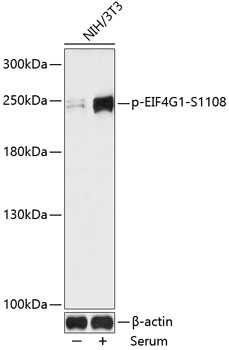
Western blot analysis of lysates from NIH/3T3 cells, using Phospho-EIF4G1-S1108 Rabbit pAb (AP0796) at 1:1000 dilution. NIH/3T3 cells were treated with 10% FBS for 30 minutes after serum-starvation overnight. Secondary antibody: HRP-conjugated Goat anti-Rabbit IgG (H+L) (AS014) at 1:10000 dilution. Lysates/proteins: 25µg per lane. Blocking buffer: 3% BSA. Detection: ECL Enhanced Kit (RM00021). Exposure time: 60s. |
Produktgarantie und fachkundiger Support
