

Phospho-EPHA2-Y594 Rabbit pAb, Unconjugated
Artikelnummer:
ABB-AP0818
- Bilder (1)
| Artikelname: | Phospho-EPHA2-Y594 Rabbit pAb, Unconjugated |
| Artikelnummer: | ABB-AP0818 |
| Hersteller Artikelnummer: | AP0818 |
| Alternativnummer: | ABB-AP0818-20UL, ABB-AP0818-100UL |
| Hersteller: | ABclonal |
| Wirt: | Rabbit |
| Kategorie: | Antikörper |
| Applikation: | ELISA, WB |
| Spezies Reaktivität: | Human |
| Immunogen: | Synthetic peptide. This information is considered to be commercially sensitive. |
| Konjugation: | Unconjugated |
| Alternative Synonym: | ECK, CTPA, ARCC2, CTPP1, CTRCT6, Phospho-EPHA2-Y594 |
| This gene belongs to the ephrin receptor subfamily of the protein-tyrosine kinase family. EPH and EPH-related receptors have been implicated in mediating developmental events, particularly in the nervous system. Receptors in the EPH subfamily typically have a single kinase domain and an extracellular region containing a Cys-rich domain and 2 fibronectin type III repeats. The ephrin receptors are divided into 2 groups based on the similarity of their extracellular domain sequences and their affinities for binding ephrin-A and ephrin-B ligands. This gene encodes a protein that binds ephrin-A ligands. Mutations in this gene are the cause of certain genetically-related cataract disorders. |
| Application Verdünnung: | WB,1:500 - 1:2000|ELISA,Recommended starting concentration is 1 µg/mL. Please optimize the concentration based on your specific assay requirements. |
| Anwendungsbeschreibung: | Cross-Reactivity: Human,Rat, ResearchArea: Protein phosphorylation,Signal Transduction,Kinase,Tyrosine kinases,Neuroscience, Cell Type Marker,Cardiovascular,Angiogenesis,Neuron marker. |
|
|
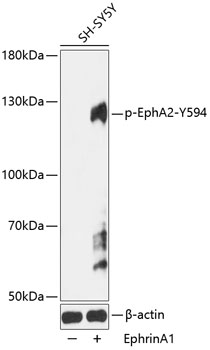
Western blot analysis of lysates from SH-SY5Y cells, using Phospho-EPHA2-Y594 Rabbit pAb (AP0818) at 1:1000 dilution. SH-SY5Y cells were treated with EphrinA1 (100 ng/mL) for 5 minutes . Secondary antibody: HRP-conjugated Goat anti-Rabbit IgG (H+L) (AS014) at 1:10000 dilution. Lysates/proteins: 25µg per lane. Blocking buffer: 3% BSA. Detection: ECL Basic Kit (RM00020). Exposure time: 60s. |
Produktgarantie und fachkundiger Support
