

Phospho-PLA2G4A-S505 Rabbit pAb, Unconjugated
Artikelnummer:
ABB-AP0968
- Bilder (1)
| Artikelname: | Phospho-PLA2G4A-S505 Rabbit pAb, Unconjugated |
| Artikelnummer: | ABB-AP0968 |
| Hersteller Artikelnummer: | AP0968 |
| Alternativnummer: | ABB-AP0968-20UL, ABB-AP0968-100UL |
| Hersteller: | ABclonal |
| Wirt: | Rabbit |
| Kategorie: | Antikörper |
| Applikation: | ELISA, WB |
| Spezies Reaktivität: | Human |
| Immunogen: | Synthetic peptide. This information is considered to be commercially sensitive. |
| Konjugation: | Unconjugated |
| Alternative Synonym: | GURDP, cPLA2, PLA2G4, cPLA2-alpha, Phospho-PLA2G4A-S505 |
| This gene encodes a member of the cytosolic phospholipase A2 group IV family. The enzyme catalyzes the hydrolysis of membrane phospholipids to release arachidonic acid which is subsequently metabolized into eicosanoids. Eicosanoids, including prostaglandins and leukotrienes, are lipid-based cellular hormones that regulate hemodynamics, inflammatory responses, and other intracellular pathways. The hydrolysis reaction also produces lysophospholipids that are converted into platelet-activating factor. The enzyme is activated by increased intracellular Ca(2+) levels and phosphorylation, resulting in its translocation from the cytosol and nucleus to perinuclear membrane vesicles. Alternative splicing results in multiple transcript variants. |
| Application Verdünnung: | WB,1:500 - 1:2000|ELISA,Recommended starting concentration is 1 µg/mL. Please optimize the concentration based on your specific assay requirements. |
| Anwendungsbeschreibung: | Cross-Reactivity: Human,Mouse,Rat, ResearchArea: Protein phosphorylation,Signal Transduction,G protein signaling,G-Protein-Coupled Receptors Signaling to MAPK Erk,MAPK-Erk Signaling Pathway,Endocrine Metabolism,Lipid Metabolism. |
|
|
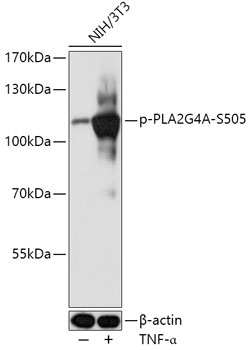
Western blot analysis of lysates from NIH/3T3 cells, using Phospho-PLA2G4A-S505 Rabbit pAb (AP0968) at 1:1000 dilution. NIH/3T3 cells were treated with TNF-alpha (20 ng/mL) at 37°C for 30 minutes. Secondary antibody: HRP-conjugated Goat anti-Rabbit IgG (H+L) (AS014) at 1:10000 dilution. Lysates/proteins: 25µg per lane. Blocking buffer: 3% BSA. Detection: ECL Basic Kit (RM00020). Exposure time: 10s. |
Produktgarantie und fachkundiger Support
