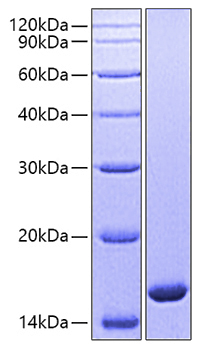
Interleukin-36 alpha(Il-36a) is a member of the IL-1 family.IL1alpha,IL1beta and IL-18 are potent inflammatory cytokines whoseactivities are dependent on heterodimeric receptors of the IL-1R superfamily, and which are regulated by solubleantagonists. Il36a is a cytokine that binds to and signals through the IL1RL2/IL-36R receptor which in turn activates NF-kappa-B and MAPK signaling pathways in target cells linked to a pro-inflammatory response. It is a part of the IL-36signaling system that is thought to be present in epithelial barriers and to take part in local inflammatory response, similarto the IL-1 system with which it shares the coreceptor IL1RAP. It Induces the production of proinflammatory cytokines, including IL-12, Il-1 beta, IL-6, TNF-alpha and IL-23 inbone marrow-derived dendritic cells (BMDCs). Moreover, it is involved in dendritic cell maturation by stimulating thesurface expression of CD80, CD86 and MHC class II and can induce the production of IFN-gamma, IL-4 and IL-17 by culturedCD4+ T cells and splenocytes. Il36a may play a role in proinflammatory effects in the lung: induces the expression of CXCL1and CXCL2 in the lung, and the expression of TNF-alpha, IL-36c, IL-1A, IL-1B, CXCL1 and CXCL2 in isolated splenic CD11c+alveolar macrophages. It may be involved in T cell maturation by stimulating the surface expression of CD40 and modestlyCD80 and CD86 in splenic CD11c+ cells and CD4+ T cell proliferation.