Recombinant Human CXCL1/GRO-alpha Protein, E. coli

Artikelnummer: ABB-RP01841
Artikelname: Recombinant Human CXCL1/GRO-alpha Protein, E. coli
Artikelnummer: ABB-RP01841
Hersteller Artikelnummer: RP01841
Alternativnummer: ABB-RP01841-50UG, ABB-RP01841-10UG, ABB-RP01841-100UG, ABB-RP01841-20UG
Hersteller: ABclonal
Wirt: E. coli
Kategorie: Proteine/Peptide
Spezies Reaktivität: Human
Immunogen: Ala35-Asn107
Alternative Synonym: CXCL1, GRO, GRO1, GROA, MGSA, SCYB1,Growth-regulated alpha protein, C-X-C motif chemokine 1, GRO-alpha(1-73), Melanoma growth stimulatory activity, MGSA, Neutrophil-activating protein 3, NAP-3, Cleaved into: GRO-alpha(4-73), GRO-alpha(5-73), GRO-alpha(6-73)
CXCL1, also known as GRO-alpha, is a polypeptide that is initially isolated from human melanoma cells. CXCL1 acts as a key chemoattractant for neutrophils by binding specifically to its corresponding G-protein-coupled receptor CXCR2. CXCL1 modulates angiogenesis, tumorigenesis, and wound healing. In general, CXCL1 levels are extremely low under normal physiological conditions and greatly increased during inflammatory conditions.The amino acid sequence of human CXCL1 protein has low homology between mouse and rat CXCL1 protein. After translation, the synthesized CXCL1 precursor is 107aa long. A signal peptide is removed from its N-terminus, which shortens the precursor to 73aa. Two other amino acids can also be removed from the C-terminus. In addition, two disulfide bridges are formed from all four cysteine residues in CXCL1. The disulfide bridges give the appropriate structure to CXCL1, which determines the properties of this chemokine. After secretion, CXCL1 undergoes further proteolytic processing, which regulates the activity of this chemokine. From the N-terminus, three, four or five amino acids are removed, which produce CXCL1(4-73), CXCL1(5-73), and CXCL1(6-73), respectively. This increases CXCL1 activity 30 times, as measured by its ability to induce the chemotaxis of treated cells. To date, three CXCL1 receptors have been discovered-CXCR1, CXCR2 and atypical chemokine receptor 1 (ACKR1). Through NF-kappaB activation, CXCL1 expression is increased by cytokines such as IL-1beta, TNF-alpha and IL-17. CXCL1 can associate into bioactive dimers and primarily signals through CXCR2/IL-8 RB. After CXCL1 expression is induced by carcinogens, it participates in inflammatory responses by recruiting neutrophils. This leads to chronic inflammation. In addition to increasing proliferation, CXCL1 also induces cancer cell migration, particularly EMT. Produced by lymphatic endothelial cells (LECs), CXCL1 enables tumor cell migration into the lymphatic vessels during lymphangiogenesis, leading to lymph node metastasis. CXCL1 is a chemotactic factor for neutrophils. Additionally, it causes the mobilization of these cells from the bone marrow. CXCL1 can also induce recruitment of regulatory T cells (Treg) and MSCs into the tumor niche. Another no-less-important property of CXCL1 is its ability to induce angiogenesis.
Konzentration: < 0.1 EU/µg of the protein by LAL method.
Molekulargewicht: 7.86 kDa
NCBI: 2919
UniProt: P09341
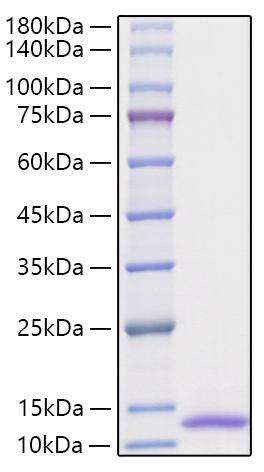
Reinheit: 95% as determined by SDS-PAGE.
Formulierung: Lyophilized from a 0.22 µm filtered solution of PBS, pH 7.4.
Target-Kategorie: CXCL1/GRO-alpha
Application Verdünnung: Lyophilized from a 0.22 µm filtered solution of PBS, pH 7.4.
Anwendungsbeschreibung: Cross-Reactivity: Centrifuge the vial before opening. Reconstitute to a concentration of 0.1-0.5 mg/mL in sterile distilled water. Avoid vortex or vigorously pipetting the protein. For long term storage,it is recommended to add a carrier protein or stablizer (e.g. 0.1% BSA,5% HSA,10% FBS or 5% Trehalose),and aliquot the reconstituted protein solution to minimize free-thaw cycles., ResearchArea: Cytokines & Cytokine receptors
Recombinant Human CXCL1/GRO-alpha Protein was determined by SDS-PAGE under reducing conditions with Coomassie Blue.