Recombinant Human Cathepsin E Protein
Artikelnummer:
ABB-RP02167
Produktübersicht
Artikelname:
Recombinant Human Cathepsin E Protein
Artikelnummer:
ABB-RP02167
Hersteller Artikelnummer:
RP02167
Alternativnummer:
ABB-RP02167-50UG,ABB-RP02167-10UG
Hersteller:
ABclonal
Wirt:
Human
Kategorie:
Proteine/Peptide
Spezies Reaktivität:
Human
Immunogen:
Ser20-Pro396
Alternative Synonym:
CTSE,CATE
Produktbeschreibung
Recombinant Human Cathepsin E Protein is produced by Mammalian expression system. The target protein is expressed with sequence (Ser20-Pro396) of human CTSE (Accession P14091) fused with a 6xHis tag at the C- terminus.
Produkteigenschaften
Konzentration:
< 1 EU/µg of the protein by LAL method.
Molekulargewicht:
41.78 kDa
Tag:
C-His
NCBI:
1510
UniProt:
P14091
Quelle:
HEK293 cells
Reinheit:
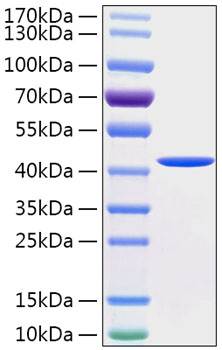
95 % as determined by SDS-PAGE.
Formulierung:
Lyophilized from a 0.2 µm filtered solution of 20mM MES, 150mM NaCl, pH 5.5.Contact us for customized product form or formulation.
Target-Kategorie:
Cathepsin E
Anwendungsbeschreibung
Application Verdünnung:
Lyophilized from a 0.2 µm filtered solution of 20mM MES, 150mM NaCl, pH 5.5.Contact us for customized product form or formulation.
Anwendungsbeschreibung:
ResearchArea: Other Recombinant Protein. Shipping: Ice Bag
Bilder
Recombinant Human Cathepsin E Protein was determined by SDS-PAGE under reducing conditions with Coomassie Blue.