Recombinant Human IFN-beta Protein

Artikelnummer: ABB-RP02774
Artikelname: Recombinant Human IFN-beta Protein
Artikelnummer: ABB-RP02774
Hersteller Artikelnummer: RP02774
Alternativnummer: ABB-RP02774-50UG, ABB-RP02774-20UG, ABB-RP02774-100UG
Hersteller: ABclonal
Wirt: Human
Kategorie: Proteine/Peptide
Spezies Reaktivität: Human
Immunogen: Met22-Asn187
Alternative Synonym: IFNB1,IFB,IFF,IFN-beta,IFNB
Interferons (IFNs) are natural glycoproteins belonging to the cytokine superfamily and are produced by the cells of the immune system of most vertebrates in response to challenges by foreign agents such as viruses, parasites, and tumor cells. Interferon-beta (IFN beta) is an extracellular protein mediator of host defense and homeostasis. IFN beta has well-established direct antiviral, antiproliferative, and immunomodulatory properties. Recombinant IFN beta is approved for the treatment of relapsing-remitting multiple sclerosis. The recombinant IFN beta protein has the theoretical potential to either treat or causes autoimmune neuromuscular disorders by altering the complicated and delicate balances within the immune system networks. It is the most widely prescribed disease-modifying therapy for multiple sclerosis (MS). Large-scale clinical trials have established the clinical efficacy of IFN beta in reducing relapses and slowing disease progression in relapsing-remitting MS. IFN beta therapy was shown to be comparably beneficial for opticospinal MS (OSMS) and conventional MS in Japanese. IFN beta is effective in reducing relapses in secondary progressive MS and may have a modest effect in slowing disability progression. In addition to the common antiviral activity, IFN beta also induces increased production of the p53 gene product which promotes apoptosis and thus has a therapeutic effect against certain cancers. The role of IFN-beta in bone metabolism could warrant its systematic evaluation as a potential adjunct to therapeutic regimens of osteolytic diseases. Furthermore, IFN beta might play a beneficial role in the development of chronic progressive CNS inflammation.
Konzentration: < 0.01 EU/µg of the protein by LAL method
Molekulargewicht: 20.87 kDa
NCBI: 3456
UniProt: P01574
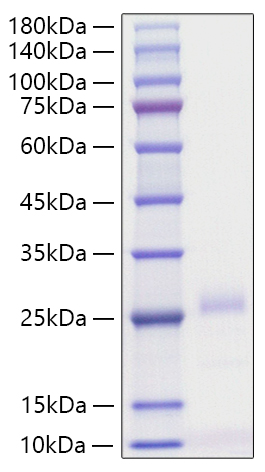
Reinheit: 95 % as determined by SDS-PAGE.
Formulierung: Lyophilized from a 0.22 µm filtered solution of 25mM NaAc PH 5.0
Sequenz: MSYNLLGFLQRSSNFQCQKLLWQLNGRLEYCLKDRMNFDIPEEIKQLQQFQKEDAALTIYEMLQNIFAIFRQDSSSTGWNETIVENLLANVYHQINHLKTVLEEKLEKEDFTRGKLMSSLHLKRYYGRILHYLKAKEYSHCAWTIVRVEILRNFYFINRLTGYLRN
Target-Kategorie: IFN-beta/IFNB1
Application Verdünnung: Lyophilized from a 0.22 µm filtered solution of 25mM NaAc PH 5.0
Anwendungsbeschreibung: Cross-Reactivity: Centrifuge the vial before opening. Reconstitute to a concentration of 0.1-0.5 mg/mL in sterile distilled water. Avoid vortex or vigorously pipetting the protein. For long term storage,it is recommended to add a carrier protein or stablizer (e.g. 0.1% BSA,5% HSA,10% FBS or 5% Trehalose),and aliquot the reconstituted protein solution to minimize free-thaw cycles. ResearchArea: Cytokines & Cytokine receptors