S100A8 is a member of the S100 protein family containing 2EF-hand calcium-binding motifs. S100 proteins are involved in the regulation of a number of cellular processes such as cell cycle progression and differentiation. Altered expression of S100A8 protein is associated with various diseases and cancers. S100A8 may have an immunoregulatory role by contributing to the regulation of fetal-maternal interactions. It may play a protective role and its absence may allow infiltration by maternal cells, a process eventually manifesting as resorption. The heterodimeric S100 protein complex S100A8/A9 which has been shown to be involved in inflammatory and neoplastic disorders. The complex can induce cell proliferation, or apoptosis, inflammation, collagen synthesis, and cell migration. S100A8/A9 has emerged as important pro-inflammatory mediator in acute and chronic inflammation. More recently, increased S100A8 and S100A9 levels were also detected in various human cancers, presenting abundant expression in neoplastic tumor cells as well as infiltrating immune cells. On the one hand, S100A8/A9 is a powerful apoptotic agent produced by immune cells, making it a very fascinating tool in the battle against cancer. It spears the risk to induce auto-immune response and may serve as a lead compound for cancer-selective therapeutics. In contrast, S100A8/A9 expression in cancer cells has also been associated with tumor development, cancer invasion or metastasis. Altogether, its expression and potential cytokine-like function in inflammation and cancer suggest that S100A8/A9 may play a key role in inflammation-associated cancer.
Lyophilized from a 0.22 µm filtered solution of 20 mM Tris, 300 mM NaCl, pH 8.0, 10 % glycerol.
Anwendungsbeschreibung:
Cross-Reactivity: Centrifuge the vial before opening. Reconstitute to a concentration of 0.1-0.5 mg/mL in sterile distilled water. Avoid vortex or vigorously pipetting the protein. For long term storage,it is recommended to add a carrier protein or stablizer (e.g. 0.1% BSA,5% HSA,10% FBS or 5% Trehalose),and aliquot the reconstituted protein solution to minimize free-thaw cycles., ResearchArea: Other Recombinant Protein
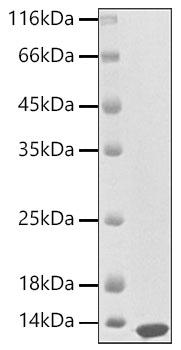
Recombinant Mouse S100-A8 Protein was determined by SDS-PAGE under reducing conditions with Coomassie Blue.
* Mehrwertsteuer und Versandkosten nicht enthalten. Irrtümer und Preisänderungen vorbehalten