CD19 is a B-cell specific cell-surface molecule of the Ig superfamily expressed by early pre-B cells in humans and mice until plasma cell differentiation. It plays a crucial role in mature B cell development as best exemplified by the finding that CD19 deficient mice have severely reduced mature B cell compartments. CD19 is specifically expressed in normal and neoplastic lymphoid cells. Human CD19 and mouse CD19 are functionally equivalent in vivo. Too high CD19 expression might result into too strong BCR signaling in the bone marrow and therefore causing negative selection. Too low CD19 expression might result into too little BCR signaling and thereby preventing the B cells to enter the mature pool (absence of positive selection). CD19 functions as the dominant signaling component of a multimolecular complex on the surface of mature B cells, alongside complement receptor CD21, and the tetraspanin membrane protein CD81 (TAPA-1), as well as CD225. CD19 plays a critical role in maintaining the balance between humoral, antigen-induced response and tolerance induction.
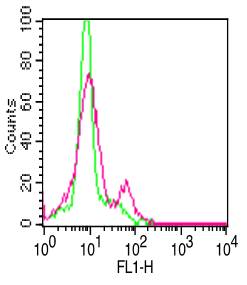
Figure-1: Cell Surface flow analysis of hCD19 in PBMC (Lymphocyte gated) using 0.5 µg/10 6 cells. Green represents isotype control (ABEOMICS), red represents hCD19 antibody (10-4127). Goat anti-mouse FITC conjugated secondary antibody (ABEOMICS) was used.
* Mehrwertsteuer und Versandkosten nicht enthalten. Irrtümer und Preisänderungen vorbehalten