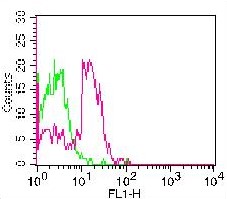
CD28 is a type I transmembrane protein that binds through its extracellular region to B7 proteins (CD80 and CD86), which are transmembrane proteins expressed on the surface of APCs (Antigen-Presenting Cells) and are up-regulated by inflammatory signals. CD28 mediates signals that promote T lymphocyte differentiation and proliferation, and enhance antibody production of B lymphocytes. Deficiencies in CD28 pathways result in complete T lymphocyte tolerance in vitro and in vivo. Both CD4+ and CD8+ memory T cells need CD28 costimulation to achieve maximal expansion and pathogen clearance. The blockade of the CD28-B7 interaction has been used to down-regulate the activation of the immune system in autoimmune diseases. Based on the expression of the costimulatory molecule CD28 on the surface of CD8+ T cells, two different lymphocyte subgroups have been designated: antigen-primed cytotoxic T cells (CD8+CD28+ T cells) and suppressor T cells (CD8+CD28 T cells). The frequency of CD28+CD8+T cells and especially the balance between CD8+CD28+ and CD8+CD28 T cells are important in many diseases, including CHB (Chronic Hepatitis B).