Recognizes a protein of 80kDa-90kDa, identified as CD36 (Workshop IV, Code P-26). Its epitope maps between aa155-183. It is expressed on platelets, monocytes and macrophages, microvascular endothelial cells, erythrocyte precursors, mammary epithelial cells, and some macrophage derived dendritic cells. CD36 acts as a receptor for thrombospondin (TSP), collagen types I, IV and V, P. falciparum malaria-infected erythrocytes, and sickle erythrocytes. It also functions as a scavenger receptor, mediating macrophage uptake of oxidized low-density lipoprotein (LDL) and recognition of apoptotic polymorphonuclear leukocytes (PMN). CD36 plays a role in platelet aggregation, macrophage foam cell development, inflammation, and the tissue ischemia observed in sickle cell disease and cerebral malaria. Note that 1-4% of Japanese and East Asia population lack CD36. This MAb blocks adhesion of P. falciparum parasitized red blood cells to CD36 and strongly inhibits collagen-induced platelet aggregation.
Functional Studies (Order Ab without Azide), Flow Cytometry (0.5-1µg/million cells in 0.1ml), Immunofluorescence (0.5-1µg/ml), Optimal dilution for a specific application should be determined.
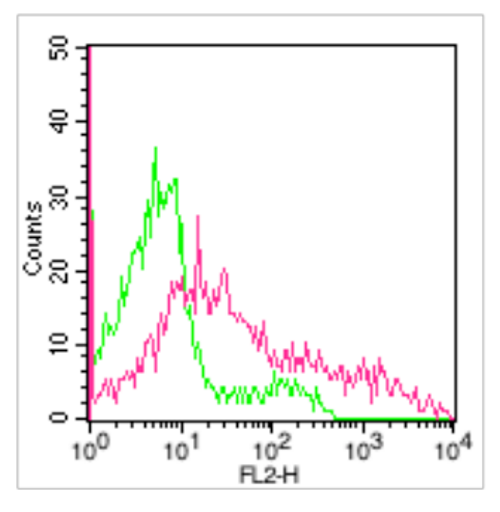
Figure 1: Cell surface FLOW staining of PBMC (monocytes gated). Green: Isotype control, Red: Cd36 (10-7666). 05 µg antibody was used. Goat anti-mouse PE conjugated secondary antibody was used.
* Mehrwertsteuer und Versandkosten nicht enthalten. Irrtümer und Preisänderungen vorbehalten