Source : HEK293 The HEK293 derived recombinant protein contains the Novel Coronavirus 2019-nCoV Spike Glycoprotein S1, Wuhan-Hu-1 strain, amino acids 1-674 fused to Sheep Fc tag at C-terminal. A human infecting coronavirus (viral pneumonia) called 2019 novel coronavirus, 2019-nCoV was found in the fish market at the city of Wuhan, Hubei province of China on December 2019. The 2019-nCoV shares an 87% identity to the 2 bat-derived severe acute respiratory syndrome 2018 SARS-CoV-2 located in Zhoushan of eastern China. 2019-nCoV has an analogous receptor-BD-structure to that of 2018 SARS-CoV, even though there is a.a. diversity so thus the 2019-nCoV might bind to ACE2 receptor protein (angiotensin-converting enzyme 2) in humans. While bats are possibly the host of 2019-nCoV, researchers suspect that animal from the ocean sold at the seafood market was an intermediate host. RSCU analysis proposes that the 2019-nCoV is a recombinant within the viral spike glycoprotein between the bat coronavirus and an unknown coronavirus.
Reinheit:
Protein is >85% pure as determined SDS-PAGE.
Antibody Type:
Recombinant Antibody
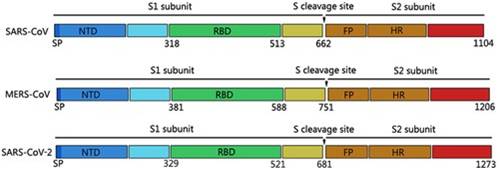
Structural diagrams of spike glycoproteins of SARS-CoV, MERS-CoV, and SARS-CoV-2. All spike proteins of coronaviruses contain S1 subunit and S2 subunit, which were divided by the S cleavage sites. FP, fusion peptide, HR, heptad repeat 1 and heptad repeat 2, RBD, receptor-binding domain, contains core binding motif in the external subdomain, SP, signal peptide. Adapted from Composition and divergence of coronavirus spike proteins and host ACE2 receptors predict potential intermediate hosts of SAR
* Mehrwertsteuer und Versandkosten nicht enthalten. Irrtümer und Preisänderungen vorbehalten