Mouse monoclonal to Neuroligin 1 (RPE). Neuroligin-1 is a neuronal cell surface protein belonging to the type-B carboxylesterase/lipase family. It is a necessary component in the maturation of excitatory synapses for their normal, functional development, and is necessary to the regulation of synaptic plasticity and the development of long-term memory within the adult amygdala in mammals. It is believed to participate in cell-cell-interaction through the assembly of intracellular junction by the binding of beta-neurexins, and may also be a factor in the maintenance and assembly of synaptic junctions. It is also thought to have involvement in excitatory synaptic specification. Within brain tissue, Neuroligin-1 is primarily observed in neurons and spinal cord..
Application Notes: 2 µg/ml of SMC-463 was sufficient for detection of Neuroligin-1 in 20 µg of rat brain lysate by colorimetric immunoblot analysis using Goat anti-mouse IgG:HRP as the secondary antibody
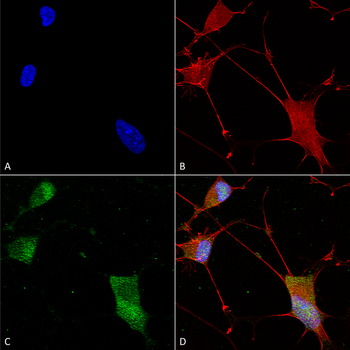
Immunocytochemistry/Immunofluorescence analysis using Mouse Anti-Neuroligin 1 Monoclonal Antibody, Clone N97A/31. Tissue: Neuroblastoma cells (SH-SY5Y). Species: Human. Fixation: 4% PFA for 15 min. Primary Antibody: Mouse Anti-Neuroligin 1 Monoclonal Antibody at 1:100 for overnight at 4C with slow rocking. Secondary Antibody: AlexaFluor 488 at 1:1000 for 1 hour at RT. Counterstain: Phalloidin-iFluor 647 (red) F-Actin stain, Hoechst (blue) nuclear stain at 1:800, 1.6mM for 20 min at RT. (A) Hoechst (blue) nuclear stain. (B) Phalloidin-iFluor 647 (red) F-Actin stain. (C) Neuroligin 1 Antibody (D) Composite.
* Mehrwertsteuer und Versandkosten nicht enthalten. Irrtümer und Preisänderungen vorbehalten