Btk is a major node in the B-cell receptor signaling pathway, where it regulates B cell maturation, activation, survival, differentiation, and proliferation. Btk is activated by Src family kinases, including Lyn, which phosphorylates Btk at Tyr551. Upon phosphorylation at this site, Btk is recruited to the plasma membrane where autophosphorylation at Tyr223 occurs. The Btk signaling pathway is a major target of small molecule inhibitors for B-cell lymphoma, autoimmune diseases, and non-Hodgkin,Aos lymphomas. These inhibitors either form a covalent bond at Cys481 in the ATP-binding site or serve as reversible inhibitors that bind the SH3 pocket and stabilize inactive Btk.
For flow cytometric staining, the suggested use of this reagent is 5 µL per million cells or 5 µL per 100 µL of staining volume. It is recommended that the reagent be titrated for optimal performance for each application.
Anwendungsbeschreibung:
Modification: Phosphorylated
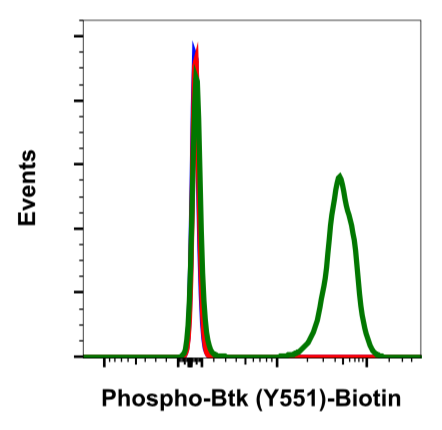
Flow cytometric analysis of Ramos cells secondary antibody only negative control (blue) or untreated (red) or treated with pervanadate (green) using Phospho-Btk (Tyr551) antibody BtkY551-G12-Biotin conjugate at 0.1 µg/mL. Cat. orb1946086.
Peptide ELISA using BtkY551-G12-Biotin conjugate (Cat. orb1946086) titered starting from 0.3 ug/mL shows binding to only Btk pY551 phospho peptide and no cross-reactivity to Btk Y551 non-phospho peptide or to control peptides.
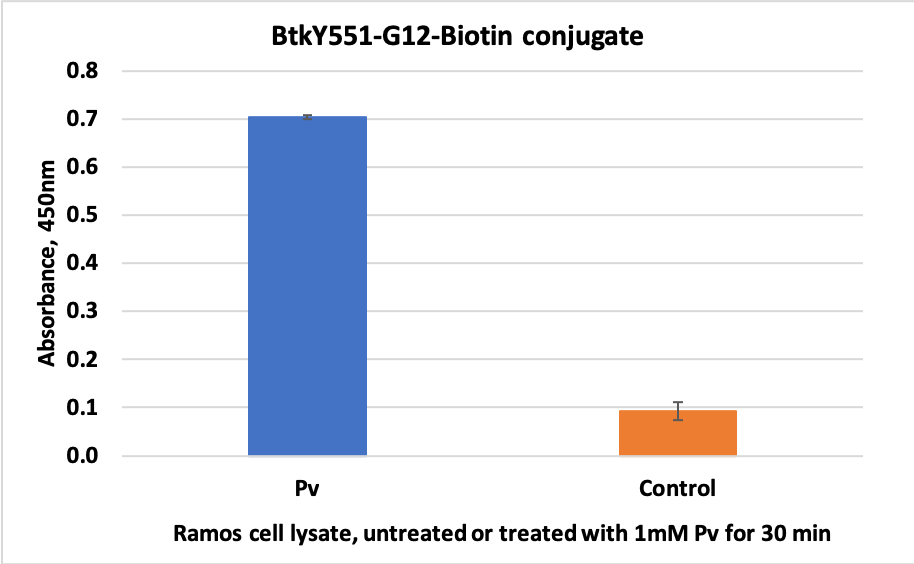
Direct ELISA using Ramos cellular lysate coated directly to the plate surface after lysis following no treatment or treatment with 1mM pervanadate for 30 min. ELISA wells were tested in duplicate using 0.12 mg/mL total protein coated lysate and 1 ug/mL BtkY551-G12-Biotin conjugate (Cat. orb1946086) IgG.
* Mehrwertsteuer und Versandkosten nicht enthalten. Irrtümer und Preisänderungen vorbehalten