Endogenous opioid peptides and opiates, like morphine, transmit their pharmacological effects through membrane bound opioid receptors. Pharmacological studies and molecular cloning have led to the identification of three different types of opioid receptor, mu-type, delta-type and kappa-type, also designated MOR-1, DOR-1 and KOR-1, respectively. MOR-1 is a receptor for beta-endorphin, DOR-1 is a receptor for enkephalins, and KOR-1 is a receptor for dynorphins.The three opioid receptor types are highly homologous and belong to the superfamily of G-protein-coupled receptors. Opioid receptors have been shown to modulate a range of brain functions, including instinctive behavior and emotions. This regulation is thought to involve the inhibition of neurotransmitter release by reducing calcium ion currents and increasing potassium ion conductance.
Klonalität:
Polyclonal
Konzentration:
1 mg/ml
Molekulargewicht:
42kD
Application Verdünnung:
Western Blot: 1/500 - 1/2000. Immunohistochemistry: 1/100 - 1/300. ELISA: 1/10000. Not yet tested in other applications.
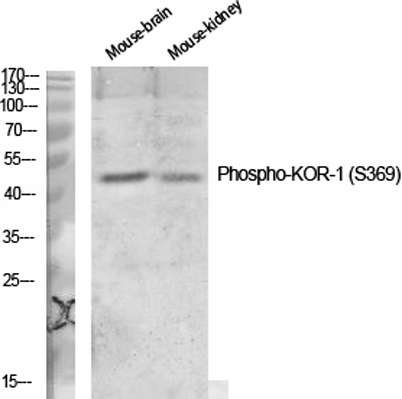
Western Blot analysis of various cells using Phospho-KOR-1 (S369) Polyclonal Antibody diluted at 1:1000
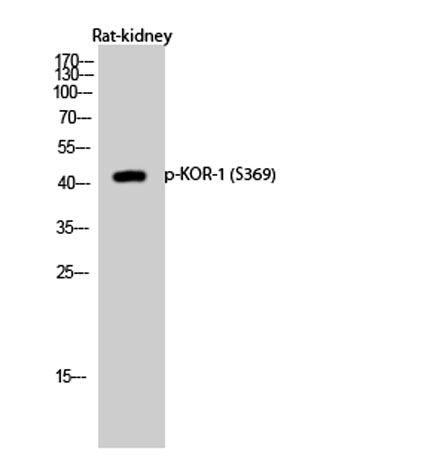
Western Blot analysis of Rat-kidney cells using Phospho-KOR-1 (S369) Polyclonal Antibody diluted at 1:1000
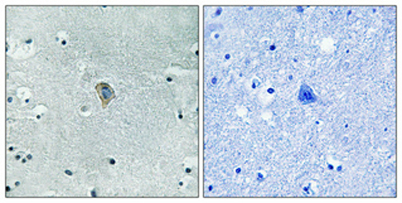
Immunohistochemical analysis of paraffin-embedded Human brain. Antibody was diluted at 1:100(4 overnight). High-pressure and temperature Tris-EDTA,pH8.0 was used for antigen retrieval. Negetive contrl (right) obtaned from antibody was pre-absorbed by immunogen peptide.
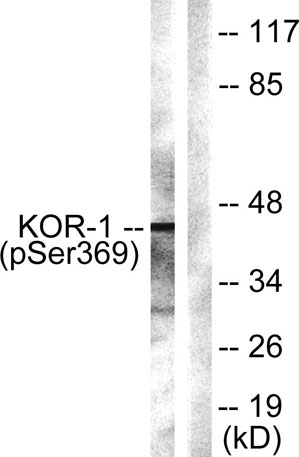
Western blot analysis of lysates from NIH/3T3 cells, using KOR-1 (Phospho-Ser369) Antibody. The lane on the right is blocked with the phospho peptide.
* Mehrwertsteuer und Versandkosten nicht enthalten. Irrtümer und Preisänderungen vorbehalten