Ephrin receptors and their ligands, the ephrins, mediate numerous developmental processes, particularly in the nervous system. Based on their structures and sequence relationships, ephrins are divided into the ephrin-A (EFNA) class, which are anchored to the membrane by a glycosylphosphatidylinositol linkage, and the ephrin-B (EFNB) class, which are transmembrane proteins. The Eph family of receptors are divided into 2 groups based on the similarity of their extracellular domain sequences and their affinities for binding ephrin-A and ephrin-B ligands. Ephrin receptors make up the largest subgroup of the receptor tyrosine kinase (RTK) family. The protein encoded by this gene is a receptor for ephrin-B family members. [provided by RefSeq, Jul 2008],
Western Blot: 1/500 - 1/2000. Immunofluorescence: 1/200 - 1/1000. ELISA: 1/5000. Not yet tested in other applications.
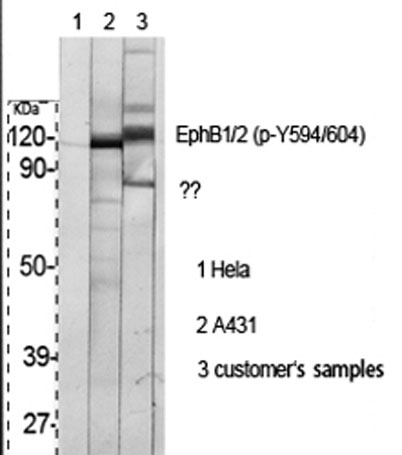
Western Blot analysis of various cells using Phospho-EphB1/2 (Y594/604) Polyclonal Antibody
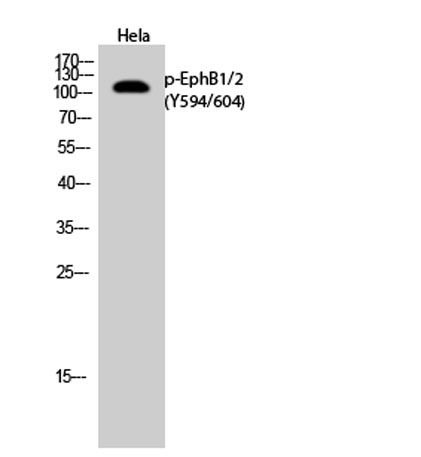
Western Blot analysis of Hela cells using Phospho-EphB1/2 (Y594/604) Polyclonal Antibody
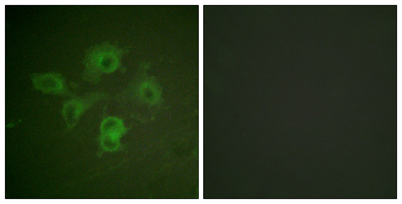
Immunofluorescence analysis of HUVEC cells, using EPHB1/2 (Phospho-Tyr594/604) Antibody. The picture on the right is blocked with the phospho peptide.
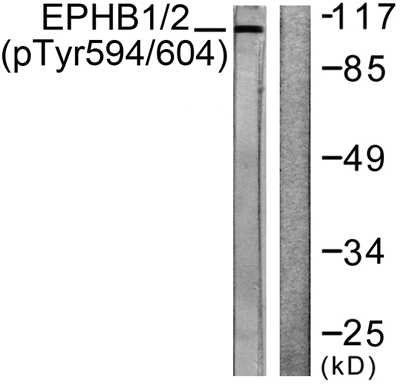
Western blot analysis of lysates from HepG2 cells, using EPHB1/2 (Phospho-Tyr594/604) Antibody. The lane on the right is blocked with the phospho peptide.
* Mehrwertsteuer und Versandkosten nicht enthalten. Irrtümer und Preisänderungen vorbehalten