The antiserum was produced against synthesized peptide derived from human PIP5K around the phosphorylation site of Ser307. AA range:273-322
Alternative Synonym:
PIKFYVE, KIAA0981, PIP5K3, 1-phosphatidylinositol 3-phosphate 5-kinase, Phosphatidylinositol 3-phosphate 5-kinase, FYVE finger-containing phosphoinositide kinase, PIKfyve, Phosphatidylinositol 3-phosphate 5-kinase type III, PIPkin-III, Type
Phosphorylated derivatives of phosphatidylinositol (PtdIns) regulate cytoskeletal functions, membrane trafficking, and receptor signaling by recruiting protein complexes to cell- and endosomal-membranes. Humans have multiple PtdIns proteins that differ by the degree and position of phosphorylation of the inositol ring. This gene encodes an enzyme (PIKfyve, also known as phosphatidylinositol-3-phosphate 5-kinase type III or PIPKIII) that phosphorylates the D-5 position in PtdIns and phosphatidylinositol-3-phosphate (PtdIns3P) to make PtdIns5P and PtdIns(3,5)biphosphate. The D-5 position also can be phosphorylated by type I PtdIns4P-5-kinases (PIP5Ks) that are encoded by distinct genes and preferentially phosphorylate D-4 phosphorylated PtdIns. In contrast, PIKfyve preferentially phosphorylates D-3 phosphorylated PtdIns. In addition to being a lipid kinase, PIKf
Immunohistochemistry: 1/100 - 1/300. Immunofluorescence: 1/200 - 1/1000. ELISA: 1/10000. Not yet tested in other applications.
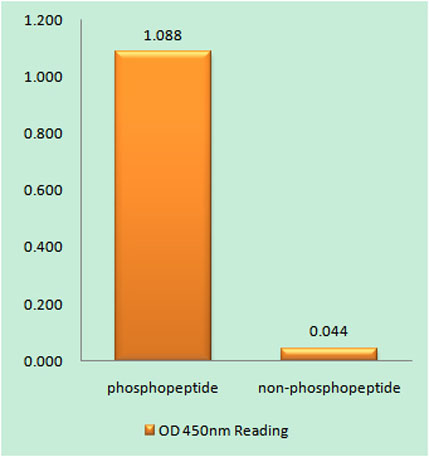
Enzyme-Linked Immunosorbent Assay (Phospho-ELISA) for Immunogen Phosphopeptide (Phospho-left) and Non-Phosphopeptide (Phospho-right), using PIP5K (Phospho-Ser307) Antibody
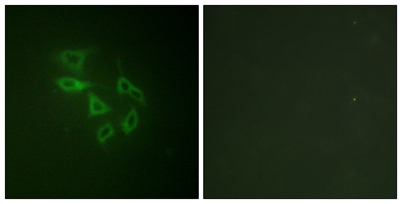
Immunofluorescence analysis of HeLa cells, using PIP5K (Phospho-Ser307) Antibody. The picture on the right is blocked with the phospho peptide.
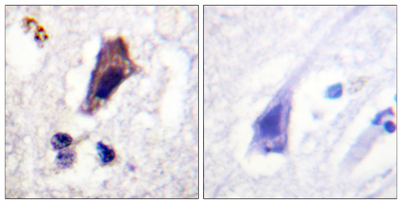
Immunohistochemistry analysis of paraffin-embedded human brain, using PIP5K (Phospho-Ser307) Antibody. The picture on the right is blocked with the phospho peptide.
* Mehrwertsteuer und Versandkosten nicht enthalten. Irrtümer und Preisänderungen vorbehalten