Kruppel Like Factor 17, Zinc Finger Protein 393, ZNF393, Novel Zinc-Finger Protein, FLJ40160, ZLF393, KLF17
Kr ppel-like factors (KLFs) comprise a family of evolutionarily conserved zinc finger-containing transcription factors with diverse regulatory functions in cell growth, proliferation, differentiation and embryogenesis. Individual members of the Sp1-like/KLF family can function either as activators or repressors, depending on which promoter they bind and which co-regulators they interact with. KLF17 (Kr ppel-like factor 17), whose alternative names include ZNF393 (zinc finger protein 393) or zfp393, is a 389 amino acid nuclear protein belonging to the Sp1 C2H2-type zinc-finger protein family. Expressed in testis and ovary, KLF17 may function as a germ cell-specific transcription factor involved in oocyte development and spermatid differentiation. Containing three C2H2-type zinc fingers which bind G/C-rich sites, KLF17 activates transcription from CACCC-box elements.
200ug/ml of Ab purified from Bioreactor Concentrate by Protein A/G. Prepared in 10mM PBS with0.05% BSA & 0.05% azide. Also available WITHOUT BSA & azide at 1.0mg/ml.
Antibody Type:
Monoclonal Antibody
Anwendungsbeschreibung:
Immunoprecipitation (1-2ug per 100-500ug of total protein), ,Western Blot (1-2ug/ml), Immunofluorescence (1-2ug/ml),,Flow Cytometry (1-2ug/million cells),,Optimal dilution for a specific application should be determined.
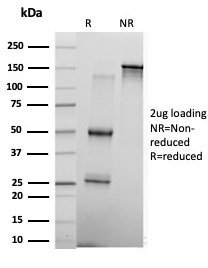
SDS-PAGE Analysis of Purified KLF17 Mouse Monoclonal Antibody (PCRP-KLF17-1G2). Confirmation of Purity and Integrity of Antibody.
Flow cytometric analysis of PFA-fixed HeLa cells. KLF17 Mouse Monoclonal Antibody (PCRP-KLF17-1G2) followed by goat anti-mouse IgG-CF488 (blue), unstained cells (red).
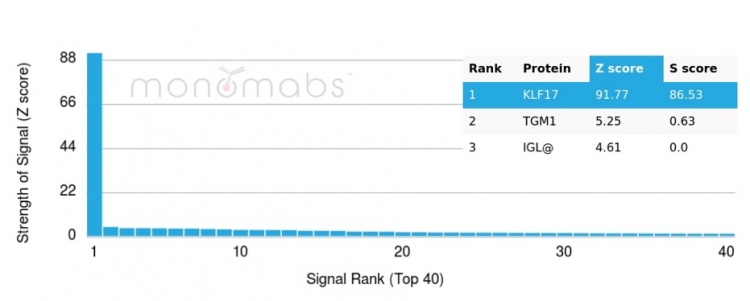
Analysis of Protein Array containing more than 19,000 full-length human proteins using KLF17 Mouse Monoclonal Antibody (PCRP-KLF17-1G2). Z- and S- Score: The Z-score represents the strength of a signal that a monoclonal antibody (MAb) (in combination with a fluorescently-tagged anti-IgG secondary antibody) produces when binding to a particular protein on the HuProtTM array. Z-scores are described in units of standard deviations (SDs) above the mean value of all signals generated on that array. If targets on HuProtTM are arranged in descending order of the Z-score, the S-score is the difference (also in units of SDs) between the Z-score. S-score therefore represents the relative target specificity of a MAb to its intended target. A MAb is considered to specific to its intended target, if the MAb has an S-score of at least 2.5. For example, if a MAb binds to protein X with a Z-score of 43 and to protein Y with a Z-score of 14, then the S-score for the binding of that MAb to protein X is equal to 29.
* Mehrwertsteuer und Versandkosten nicht enthalten. Irrtümer und Preisänderungen vorbehalten