DC-SIGN is a transmembrane receptor that is expressed on the surface of dendritic cells and macrophages. It is involved in the innate immune system and recognizes numerous evolutionarily divergent pathogens ranging from parasites to viruses. The protein is organized into three distinct domains: an N-terminal transmembrane domain, a tandem-repeat neck domain and C-type lectin carbohydrate recognition domain. The extracellular region consisting of the C-type lectin and neck domains has a dual function as a pathogen recognition receptor and a cell adhesion receptor by binding carbohydrate ligands on the surface of microbes and endogenous cells. The neck region is important for homo-oligomerization, which allows the receptor to bind multivalent ligands with high avidity.
200ug/ml of Ab Purified from Bioreactor Concentrate by Protein A/G. Prepared in 10mM PBS with 0.05% BSA & 0.05% azide. Also available WITHOUT BSA & azide at 1.0mg/ml.
Antibody Type:
Recombinant Monoclonal Antibody
Anwendungsbeschreibung:
Immunohistochemistry (Formalin-fixed) (1-2ug/ml for 30 minutes at RT),(Staining of formalin-fixed tissues is enhanced by heating tissue sections in 10mM Tris with 1mM EDTA Buffer, pH 9.0, for 45 min at 95°C followed by cooling at RT for 20 minutes),Op
Formalin-fixed, paraffin-embedded human Small Intestine stained with CD209 Recombinant Rabbit Monoclonal Antibody (C209/2749R).
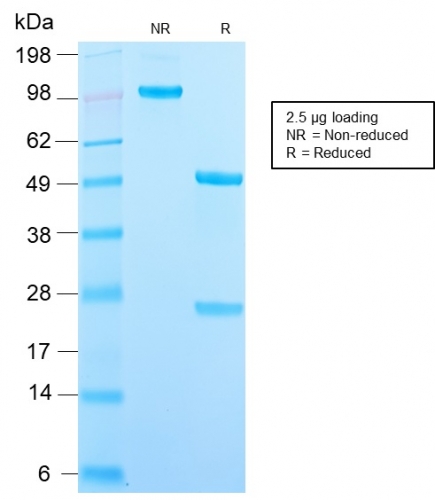
SDS-PAGE Analysis of Purified CD209 Recombinant Rabbit Monoclonal Antibody (C209/2749R). Confirmation of Purity and Integrity of Antibody.
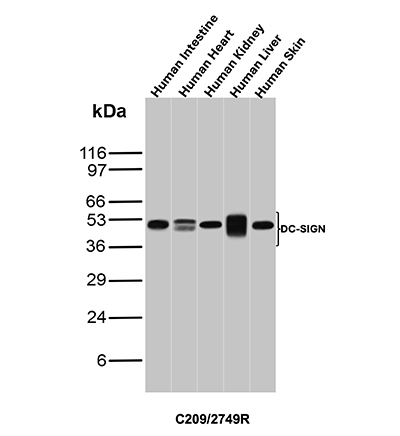
Western blot analysis of Human Intestine, Human Heart, Human Kidney, Human Liver, and Human Skin tissue lysates using DC-SIGN Recombinant Rabbit Monoclonal Antibody (C209/2749R).
Western blot analysis of Intestine, Liver and Lung tissue lysates of different species using DC-SIGN Recombinant Rabbit Monoclonal Antibody (C209/2749R).
* Mehrwertsteuer und Versandkosten nicht enthalten. Irrtümer und Preisänderungen vorbehalten