This antibody was prepared from whole rabbit serum produced by repeated immunizations with a synthetic peptide corresponding to amino acids 2503-2517 of Human PARC (C-terminus) coupled to KLH.
Konjugation:
Unconjugated
Alternative Synonym:
rabbit anti-PARC Antibody, p53 associated parkin like cytoplasmic protein antibody, RP3 330M21.2 antibody, UbcH 7 associated protein 1 antibody
ELISA: 1:2,000 - 1:10,000, IHC: User Optimized, IP: User Optimized, WB: 1:500 - 1:1,000
Anwendungsbeschreibung:
Anti-PARC reacts with human and mouse PARC by western blot and immunoprecipitation. The antibody immunoprecipitates protein from cell lysates (using HeLa, NIH-3T3, and others). To date co-immunoprecipitation using 35S-IP has been negative. A 281.2 kDa ba
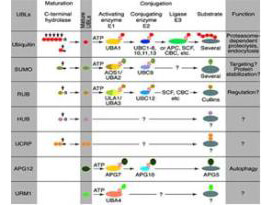
Most modifiers mature by proteolytic processing from inactive precursors (a, amino acid). Arrowheads point to the cleavage sites. Ubiquitin is expressed either as polyubiquitin or as a fusion with ribosomal proteins. Conjugation requires activating (E1) and conjugating (E2) enzymes that form thiolesters (S) with the modifiers. Modification of cullins by RUB involves SCF(SKP1/cullin-1/F-box protein) /CBC(cullin-2/elongin B/elonginC) -like E3 enzymes that are also involved in ubiquitination. In contrast to ubiquitin, the UBLs do not seem to form multi-UBL chains. UCRP(ISG15) resembles two ubiquitin moieties linked head-to-tail. Whether HUB1 functions as a modifier is currently unclear. APG12 and URM1 are distinct from the other modifiers because they are unrelated in sequence to ubiquitin. Data contributed by S.Jentsch.
* Mehrwertsteuer und Versandkosten nicht enthalten. Irrtümer und Preisänderungen vorbehalten