MAD1L1 Antibody, IgG2b, Clone: [9B10], Mouse, Monoclonal

Artikelnummer: ROC-200-301-903
Artikelname: MAD1L1 Antibody, IgG2b, Clone: [9B10], Mouse, Monoclonal
Artikelnummer: ROC-200-301-903
Hersteller Artikelnummer: 200-301-903
Alternativnummer: ROC-200-301-903
Hersteller: Rockland Immunochemicals
Wirt: Mouse
Kategorie: Antikörper
Spezies Reaktivität: Human
Immunogen: This protein A purified monoclonal antibody was produced by repeated immunizations with full-length recombinant human MAD1L1 protein.
Konjugation: Unconjugated
Alternative Synonym: mouse anti-MAD1L1 antibody, Mitotic arrest deficient 1 antibody, Mitotic checkpoint MAD1 protein homolog antibody, Mitotic spindle assembly checkpoint protein MAD1 antibody, PIG9 antibody, Tax binding protein 181 antibody
Klonalität: Monoclonal
Konzentration: 1.0 mg/mL by UV absorbance at 280 nm
Klon-Bezeichnung: [9B10]
Isotyp: IgG2b
NCBI: 8379
UniProt: Q9Y6D9
Puffer: 0.02 M Potassium Phosphate, 0.15 M Sodium Chloride, pH 7.2
Formulierung: Liquid (sterile filtered)
Target-Kategorie: Human
Antibody Type: Primary Antibody
Application Verdünnung: ELISA: 1:5,000 - 1:20,000, IP: 1:100, WB: 1:200 - 1:1,000
Anwendungsbeschreibung: This protein A purified antibody is suitable for use in flow cytometry, immunoprecipitation, immunofluorescence and western blot. Specific conditions for reactivity should be optimized by the end user. Expect a predominant band at ~ 83 kDa corresponding
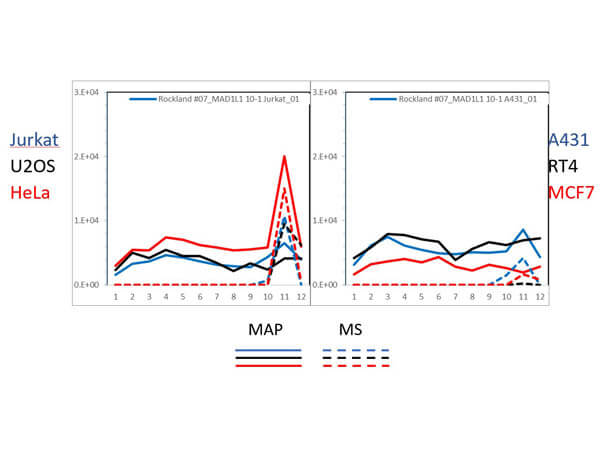
PAGE-MAP (microsphere affinity proteomics) of Mouse Anti-MAD1L1 Antibody (Catalog Number: 200-301-903, Lot Number: 17028). Antibody array western blot binding of gelfree size separated fractions of multiple lysates (solid lines) and shotgun mass spectroscopy identification (dashed lines) of the target band run in parallel correlate confirming the specificity of this antibody against MAD1L1. Data was provided by the Lund-Johansen lab of Oslo University Hospital. For more information on PAGE-MAP/IP-MS identification of antibody specificity and its large-scale implementation for antibody validation see Sikorski et. al., (2018) Nature Methods 15, 909-912.