This affinity purified antibody was prepared from whole rabbit serum produced by repeated immunizations with a synthetic peptide corresponding to amino acids 26-35 of Saccharomyces cerevisiae Mer2 protein.
This affinity purified antibody has been tested for use in ELISA and by western blot. Specific conditions for reactivity should be optimized by the end user. Expect a band approximately 50 kDa in size corresponding to Mer2 protein by western blotting in
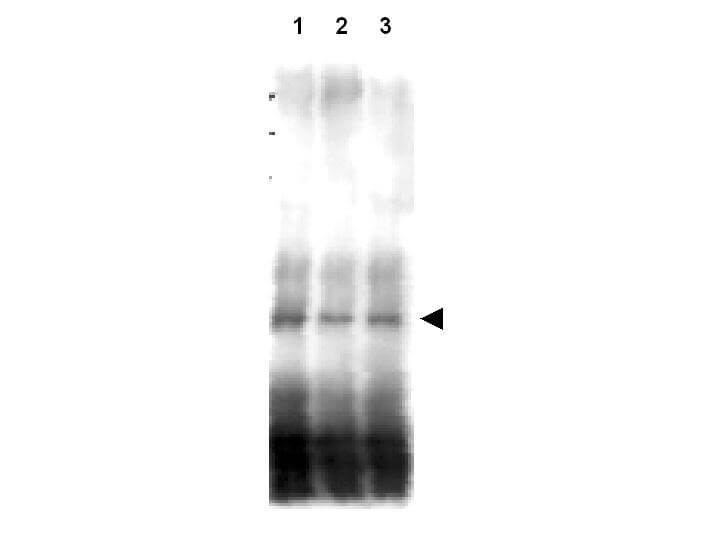
Western blot using Rocklands affinity purified anti-S.cerevisiae Mer2 antibody shows detection of phosphorylated and unphosphorylated Mer2 in wild type, phosphatase treated and mutant cells. Lane 1 contains Mer2-myc protein detected in wild type cells after first immunoprecipitating the protein using anti-myc antibody. Cells were harvested 4 h after the initiation of meiosis and therefore contain mostly phosphorylated Mer2. Lane 2 contains the same preparation after treatment with phosphatase. Lane 3 contains Mer2-S30A protein as a phosphorylation control. This antibody is reactive with both phosphorylated and unphosphorylated Mer2 at the S30 position. The primary antibody was used at a 1:5,000 dilution. Personal Communication. Michael Lichten, NIH, CCR, Bethesda, MD.
* Mehrwertsteuer und Versandkosten nicht enthalten. Irrtümer und Preisänderungen vorbehalten