This affinity purified antibody was prepared from whole rabbit serum produced by repeated immunizations with a phosphorylated synthetic peptide corresponding to the region of amino acids containing serine 206 of human SMAD1 protein.
Konjugation:
Unconjugated
Alternative Synonym:
rabbit anti-SMAD1 pS206 antibody, SMAD-1, SMAD 1, mothers against decapentaplegic homolog 1 antibody, MAD homolog 1, Mothers against DPP homolog 1, SMAD family member 1, MADH1, MADH 1, Transforming growth factor-beta-signaling protein 1, BSP-1, JV4-1
0.02 M Potassium Phosphate, 0.15 M Sodium Chloride, pH 7.2
Formulierung:
Liquid (sterile filtered)
Target-Kategorie:
Human
Antibody Type:
Primary Antibody
Application Verdünnung:
ELISA: 1:25,000-1:30,000, IP: 2 ug, WB: 1:500
Anwendungsbeschreibung:
This affinity purified antibody has been tested for use in ELISA and by western blot. Specific conditions for reactivity should be optimized by the end user. Expect a band approximately 52 kDa in size corresponding to phosphorylated SMAD1 protein by west
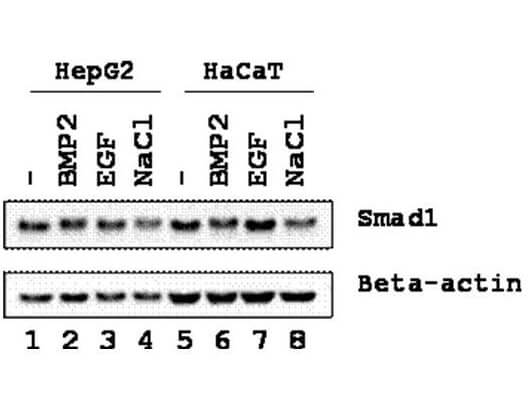
Western blot using Rocklands Affinity Purified anti-SMAD1 antibody shows detection of endogenous SMAD1 in whole cell lysates from human hepatoma (HEPG2, lanes 1-4) and keratinocyte (HaCaT, lanes 5-8) derived cell lines treated with PBS, BMP2, EGF, or NaCl for 1 h at 37C before harvest. Each lane contains approximately 15 µg of lysate. Primary antibody was used at a 1:500 dilution in 1% BLOTTO (p/n B501-0500) and reacted for 1 hour at room temperature. Anti-beta actin (p/n 600-401-886) staining was used as a loading control. The membrane was washed and reacted with a 1:3,000 dilution HRP-conjugated a-Rabbit IgG (p/n 611-103-122) for 1 hour at room temperature. Detection was by ECL. Personal communication, Xin-Hua Feng, Baylor College of Medicine, Houston, TX
* Mehrwertsteuer und Versandkosten nicht enthalten. Irrtümer und Preisänderungen vorbehalten