Anti-Guinea Pig IgG F(c) antibody has been assayed against 1.0 ug of Sheep IgG in a standard capture ELISA using ABTS (2,2-azino-bis-[3-ethylbenthiazoline-6-sulfonic acid]) code ABTS-100 as a substrate for 30 minutes at room temperature. A working dil
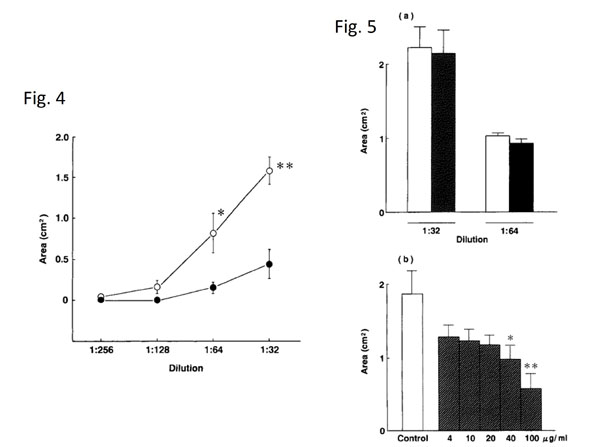
The 4-h and 7-d PCA reactions during the Challenges/Boosters of Pollen Instillation.On the 20th day after the 1st immunization, sera was obtained to estimate IgG and IgG antibody reactions using 4-h and 7-d PCAs, respectively. As shown in [Fig 4.], a significant effect was observed in 4-h PCA with a titer of 1:64 and 1:32 dilutions. Seven-day PCA was also elevated with a titer of 1:32 dilutions. The 4-h PCA reaction was not abolished with the heat (56C, 4h) [Fig 5a], but the PCA reaction was significantly abolished by antibody absorbed with IgG-Fc antibody at concentrations of 40 and 100µg/mL [Fig 5b].Fig 4. PCA reaction induced by Anti-Cedar Pollen Antibody in Guinea Pigs. Each value shows mean SEM (n=5). Unfilled circle = 4h, black filled circle = 7d. *, ** Significantly different from 7-d sensitized group at p<0.01 and p<0.05, respectively. Fig 5. PCA reaction induced by antibody treatment by heat and absorbing with IgG-Fc in Guinea Pigs. (a) Effect of incubation at 56C for 4h. Each value shows mean SEM (n=5). Unfilled bar = control, black filled bar = incubation at 56C for 4h. (b) Effect of antibody absorbed with IgG-Fc. Each value shows mean SEM (n=5). *, ** Significantly different from 7-d sensitized group at p<0.01 and p<0.05, respectively. Fig 4 and 5. PMID: 10823665.
* Mehrwertsteuer und Versandkosten nicht enthalten. Irrtümer und Preisänderungen vorbehalten