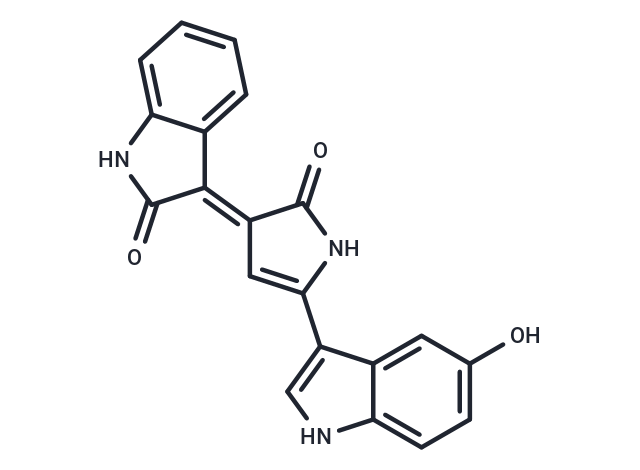
Violacein is a bacterial metabolite originally isolated from C. violaceum that has antibacterial and antiprotozoal activities.[1] [2] It is produced by C. violaceum as a purple pigment in response to N-hexanoyl homoserine lactone , a property that has been modified to create a strain of C. violaceum used in detecting quorum-sensing molecules.[3] Violacein is active against Gram-positive bacteria, including B. subtilis and S. aureus (MICs = 0.8 and 1.6 &181M, respectively). It is also active against P. falciparum, including chloroquine-susceptible and -resistant strains (IC50s = 0.85 and 0.63 &181M, respectively).[2] It reduces parasitemia in a mouse model of nonlethal P. chabaudi chabaudi infection when administered at a dose of 7.5 mg/kg and increases survival in a mouse model of lethal P. chabaudi chabaudi infection. Violacein permeabilizes the cytoplasmic membrane of bacterial cells but does not affect the cell wall.[1]
Molekulargewicht:
343.34
CAS Nummer:
[548-54-9]
Formel:
C20H13N3O3
Target-Kategorie:
Apoptosis|||Others|||Endogenous Metabolite
T35751
* Mehrwertsteuer und Versandkosten nicht enthalten. Irrtümer und Preisänderungen vorbehalten