

Pepsinogen II (PG II) Rabbit pAb, Unconjugated, Polyclonal
Catalog Number:
ABB-A2788
- Images (1)
| Article Name: | Pepsinogen II (PG II) Rabbit pAb, Unconjugated, Polyclonal |
| Biozol Catalog Number: | ABB-A2788 |
| Supplier Catalog Number: | A2788 |
| Alternative Catalog Number: | ABB-A2788-500UL,ABB-A2788-1000UL,ABB-A2788-20UL,ABB-A2788-100UL |
| Manufacturer: | ABclonal |
| Host: | Rabbit |
| Category: | Antikörper |
| Application: | ELISA, IHC-P, WB |
| Species Reactivity: | Human |
| Immunogen: | Synthetic peptide. This information is considered to be commercially sensitive. |
| Conjugation: | Unconjugated |
| Alternative Names: | PEPC, PGII, Pepsinogen II (PG II) |
| This gene encodes an aspartic proteinase that belongs to the peptidase family A1. The encoded protein is a digestive enzyme that is produced in the stomach and constitutes a major component of the gastric mucosa. This protein is also secreted into the serum. This protein is synthesized as an inactive zymogen that includes a highly basic prosegment. This enzyme is converted into its active mature form at low pH by sequential cleavage of the prosegment that is carried out by the enzyme itself. Polymorphisms in this gene are associated with susceptibility to gastric cancers. Serum levels of this enzyme are used as a biomarker for certain gastric diseases including Helicobacter pylori related gastritis. Alternate splicing results in multiple transcript variants. A pseudogene of this gene is found on chromosome 1. |
| Application Dilute: | WB,1:500 - 1:2000|IHC-P,1:100 - 1:200|ELISA,Recommended starting concentration is 1 µg/mL. Please optimize the concentration based on your specific assay requirements. |
| Application Notes: | Cross-Reactivity: Human,Mouse,Rat. ResearchArea: Cancer,Tumor biomarkers,Signal Transduction,Endocrine Metabolism,Amino acid metabolism. Shipping: Ice Bag |
|
|
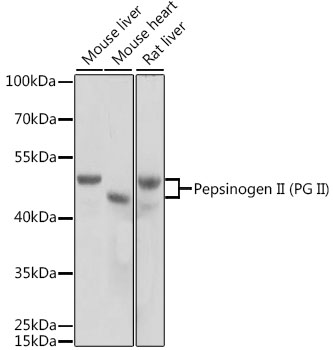
Western blot analysis of various lysates using Pepsinogen II (PG II) Rabbit pAb (A2788) at 1:1000 dilution. Secondary antibody: HRP-conjugated Goat anti-Rabbit IgG (H+L) (AS014) at 1:10000 dilution. Lysates/proteins: 25µg per lane. Blocking buffer: 3% nonfat dry milk in TBST. Detection: ECL Basic Kit (RM00020). Exposure time: 5s. |
Product Guarantee and Expert Support
