

GRPR Rabbit pAb, Unconjugated, Polyclonal
Catalog Number:
ABB-A2940
- Images (1)
| Article Name: | GRPR Rabbit pAb, Unconjugated, Polyclonal |
| Biozol Catalog Number: | ABB-A2940 |
| Supplier Catalog Number: | A2940 |
| Alternative Catalog Number: | ABB-A2940-500UL,ABB-A2940-1000UL,ABB-A2940-100UL,ABB-A2940-20UL |
| Manufacturer: | ABclonal |
| Host: | Rabbit |
| Category: | Antikörper |
| Application: | ELISA, WB |
| Species Reactivity: | Human |
| Immunogen: | Recombinant protein (or fragment).This information is considered to be commercially sensitive. |
| Conjugation: | Unconjugated |
| Alternative Names: | BB2, BB2R, BRS2, GRPR |
| Gastrin-releasing peptide (GRP) regulates numerous functions of the gastrointestinal and central nervous systems, including release of gastrointestinal hormones, smooth muscle cell contraction, and epithelial cell proliferation and is a potent mitogen for neoplastic tissues. The effects of GRP are mediated through the gastrin-releasing peptide receptor. This receptor is a glycosylated, 7-transmembrane G-protein coupled receptor that activates the phospholipase C signaling pathway. The receptor is aberrantly expressed in numerous cancers such as those of the lung, colon, and prostate. An individual with autism and multiple exostoses was found to have a balanced translocation between chromosome 8 and a chromosome X breakpoint located within the gastrin-releasing peptide receptor gene. |
| Clonality: | Polyclonal |
| Molecular Weight: | 43kDa |
| NCBI: | 2925 |
| UniProt: | P30550 |
| Purity: | Affinity purification |
| Sequence: | KNLIQSAYNLPVEGNIHVKKQIESRKRLAKTVLVFVGLFAFCWLPNHVIYLYRSYHYSEVDTSMLHFVTSICARLLAFTNSCVNPFALYLLSKSFRKQFNTQLLCCQPGLIIRSHSTGRSTTCMTSLKSTNPSVATFSLINGNICHERYV |
| Target: | GRPR |
| Antibody Type: | Primary Antibody |
| Application Dilute: | WB,1:500 - 1:2000|ELISA,Recommended starting concentration is 1 µg/mL. Please optimize the concentration based on your specific assay requirements. |
| Application Notes: | Cross-Reactivity: Human,Mouse,Rat. ResearchArea: Signal Transduction,G protein signaling,G-Protein-Coupled ReceptorsGPCR,Neuroscience. Shipping: Ice Bag |
|
|
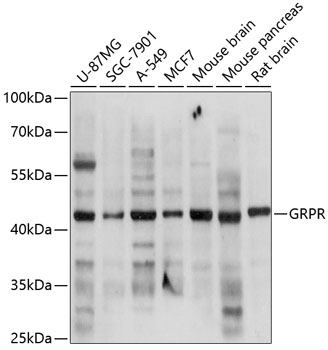
Western blot analysis of various lysates using GRPR Rabbit pAb (A2940) at 1:3000 dilution. Secondary antibody: HRP-conjugated Goat anti-Rabbit IgG (H+L) (AS014) at 1:10000 dilution. Lysates/proteins: 25µg per lane. Blocking buffer: 3% nonfat dry milk in TBST. Detection: ECL Basic Kit (RM00020). Exposure time: 15s. |
Product Guarantee and Expert Support
