

OPRL1 Rabbit pAb, Unconjugated, Polyclonal
Catalog Number:
ABB-A3113
- Images (1)
| Article Name: | OPRL1 Rabbit pAb, Unconjugated, Polyclonal |
| Biozol Catalog Number: | ABB-A3113 |
| Supplier Catalog Number: | A3113 |
| Alternative Catalog Number: | ABB-A3113-20UL,ABB-A3113-500UL,ABB-A3113-1000UL,ABB-A3113-100UL |
| Manufacturer: | ABclonal |
| Host: | Rabbit |
| Category: | Antikörper |
| Application: | ELISA, WB |
| Species Reactivity: | Human |
| Immunogen: | Synthetic peptide. This information is considered to be commercially sensitive. |
| Conjugation: | Unconjugated |
| Alternative Names: | NOP, OOR, KOR3, NOPr, OPRL, ORL1, KOR-3, NOCIR, PNOCR, OPRL1 |
| The protein encoded by this gene is a member of the 7 transmembrane-spanning G protein-coupled receptor family, and functions as a receptor for the endogenous, opioid-related neuropeptide, nociceptin/orphanin FQ. This receptor-ligand system modulates a variety of biological functions and neurobehavior, including stress responses and anxiety behavior, learning and memory, locomotor activity, and inflammatory and immune responses. A promoter region between this gene and the 5-adjacent RGS19 (regulator of G-protein signaling 19) gene on the opposite strand functions bi-directionally as a core-promoter for both genes, suggesting co-operative transcriptional regulation of these two functionally related genes. Alternatively spliced transcript variants have been described for this gene. A recent study provided evidence for translational readthrough in this gene, and expression of an additional C-terminally extended isoform via the use of an alternative in-frame translation termination codon. |
| Application Dilute: | WB,1:500 - 1:2000|ELISA,Recommended starting concentration is 1 µg/mL. Please optimize the concentration based on your specific assay requirements. |
| Application Notes: | Cross-Reactivity: Human. ResearchArea: Signal Transduction,G protein signaling,G-Protein-Coupled ReceptorsGPCR,Endocrine Metabolism,Endocrine and metabolic diseases,Obesity,Neuroscience. Shipping: Ice Bag |
|
|
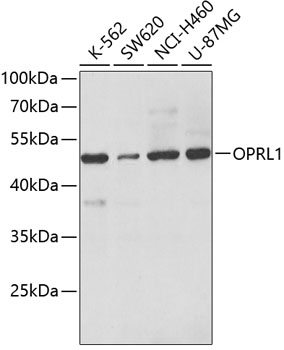
Western blot analysis of various lysates using OPRL1 Rabbit pAb (A3113) at 1:500 dilution. Secondary antibody: HRP-conjugated Goat anti-Rabbit IgG (H+L) (AS014) at 1:10000 dilution. Lysates/proteins: 25µg per lane. Blocking buffer: 3% nonfat dry milk in TBST. Detection: ECL Enhanced Kit (RM00021). |
Product Guarantee and Expert Support
