

SSTR1 Rabbit pAb, Unconjugated, Polyclonal
Catalog Number:
ABB-A3134
- Images (1)
| Article Name: | SSTR1 Rabbit pAb, Unconjugated, Polyclonal |
| Biozol Catalog Number: | ABB-A3134 |
| Supplier Catalog Number: | A3134 |
| Alternative Catalog Number: | ABB-A3134-500UL,ABB-A3134-1000UL,ABB-A3134-20UL,ABB-A3134-100UL |
| Manufacturer: | ABclonal |
| Host: | Rabbit |
| Category: | Antikörper |
| Application: | ELISA, WB |
| Species Reactivity: | Human |
| Immunogen: | Recombinant protein (or fragment).This information is considered to be commercially sensitive. |
| Conjugation: | Unconjugated |
| Alternative Names: | SS1R, SST1, SS1-R, SRIF-2, SS-1-R, SSTR1 |
| Somatostatins are peptide hormones that regulate diverse cellular functions such as neurotransmission, cell proliferation, and endocrine signaling as well as inhibiting the release of many hormones and other secretory proteins. Somatostatin has two active forms of 14 and 28 amino acids. The biological effects of somatostatins are mediated by a family of G-protein coupled somatostatin receptors that are expressed in a tissue-specific manner. The protein encoded by this gene is a member of the superfamily of somatostatin receptors having seven transmembrane segments. Somatostatin receptors form homodimers and heterodimers with other members of the superfamily as well as with other G-protein coupled receptors and receptor tyrosine kinases. This somatostatin receptor has greater affinity for somatostatin-14 than -28. |
| Application Dilute: | WB,1:500 - 1:2000|ELISA,Recommended starting concentration is 1 µg/mL. Please optimize the concentration based on your specific assay requirements. |
| Application Notes: | Cross-Reactivity: Human,Rat. ResearchArea: Signal Transduction,G protein signaling,G-Protein-Coupled ReceptorsGPCR,Neuroscience. Shipping: Ice Bag |
|
|
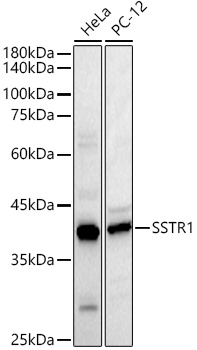
Western blot analysis of various lysates, using SSTR1 Rabbit pAb (A3134) at 1:400 dilution. Secondary antibody: HRP-conjugated Goat anti-Rabbit IgG (H+L) (AS014) at 1:10000 dilution. Lysates/proteins: 25µg per lane. Blocking buffer: 3% nonfat dry milk in TBST. Detection: ECL Basic Kit (RM00020). Exposure time: 90s. |
Product Guarantee and Expert Support
