

Vitronectin Rabbit mAb, Unconjugated, Monoclonal
Catalog Number:
ABB-A4883
- Images (1)
| Article Name: | Vitronectin Rabbit mAb, Unconjugated, Monoclonal |
| Biozol Catalog Number: | ABB-A4883 |
| Supplier Catalog Number: | A4883 |
| Alternative Catalog Number: | ABB-A4883-20UL,ABB-A4883-100UL |
| Manufacturer: | ABclonal |
| Host: | Rabbit |
| Category: | Antikörper |
| Application: | ELISA, WB |
| Species Reactivity: | Human |
| Immunogen: | Synthetic peptide. This information is considered to be commercially sensitive. |
| Conjugation: | Unconjugated |
| Alternative Names: | VN, V75, VNT, Vitronectin |
| The protein encoded by this gene functions in part as an adhesive glycoprotein. Differential expression of this protein can promote either cell adhesion or migration as it links cells to the extracellular matrix through a variety of ligands. These ligands include integrins, plasminogen activator inhibitor-1, and urokinase plasminogen activator receptor. This secreted protein can be present in the plasma as a monomer or dimer and forms a multimer in the extracellular matrix of several tissues. This protein also inhibits the membrane-damaging effect of the terminal cytolytic complement pathway and binds to several serpin serine protease inhibitors. This protein can also promote extracellular matrix degradation and thus plays a role in tumorigenesis. It is involved in a variety of other biological processes such as the regulation of the coagulation pathway, wound healing, and tissue remodeling. The heparin-binding domain of this protein give it anti-microbial properties. It is also a lipid binding protein that forms a principal component of high density lipoprotein. |
| Application Dilute: | WB,1:500 - 1:2000|ELISA,Recommended starting concentration is 1 µg/mL. Please optimize the concentration based on your specific assay requirements. |
| Application Notes: | Cross-Reactivity: Human. ResearchArea: Immunology Inflammation,Cell Intrinsic Innate Immunity Signaling Pathway,Cardiovascular,Blood,Serum Proteins. Shipping: Ice Bag |
|
|
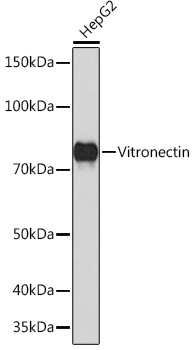
Western blot analysis of lysates from HepG2 cells, using Vitronectin Rabbit mAb (A4883) at 1:1000 dilution. Secondary antibody: HRP-conjugated Goat anti-Rabbit IgG (H+L) (AS014) at 1:10000 dilution. Lysates/proteins: 25µg per lane. Blocking buffer: 3% nonfat dry milk in TBST. Detection: ECL Basic Kit (RM00020). Exposure time: 3min. |
Product Guarantee and Expert Support
