

ING3 Rabbit pAb, Unconjugated, Polyclonal
Catalog Number:
ABB-A5832
- Images (1)
| Article Name: | ING3 Rabbit pAb, Unconjugated, Polyclonal |
| Biozol Catalog Number: | ABB-A5832 |
| Supplier Catalog Number: | A5832 |
| Alternative Catalog Number: | ABB-A5832-20UL,ABB-A5832-100UL,ABB-A5832-500UL,ABB-A5832-1000UL |
| Manufacturer: | ABclonal |
| Host: | Rabbit |
| Category: | Antikörper |
| Application: | ELISA, WB |
| Species Reactivity: | Human |
| Immunogen: | Recombinant protein (or fragment).This information is considered to be commercially sensitive. |
| Conjugation: | Unconjugated |
| Alternative Names: | Eaf4, ING2, MEAF4, p47ING3, ING3 |
| The protein encoded by this gene is similar to ING1, a tumor suppressor protein that can interact with TP53, inhibit cell growth, and induce apoptosis. This protein contains a PHD-finger, which is a common motif in proteins involved in chromatin remodeling. This gene can activate p53 trans-activated promoters, including promoters of p21/waf1 and bax. Overexpression of this gene has been shown to inhibit cell growth and induce apoptosis. Allelic loss and reduced expression of this gene were detected in head and neck cancers. Two alternatively spliced transcript variants encoding different isoforms have been observed. |
| Application Dilute: | WB,1:500 - 1:2000|ELISA,Recommended starting concentration is 1 µg/mL. Please optimize the concentration based on your specific assay requirements. |
| Application Notes: | Cross-Reactivity: Human,Mouse,Rat. ResearchArea: Epigenetics Nuclear Signaling,Cancer,Tumor suppressors. Shipping: Ice Bag |
|
|
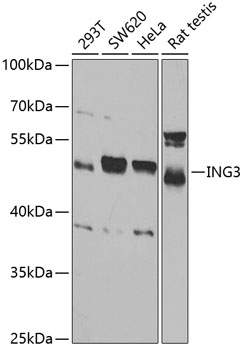
Western blot analysis of various lysates using ING3 Rabbit pAb (A5832) at 1:1000 dilution. Secondary antibody: HRP-conjugated Goat anti-Rabbit IgG (H+L) (AS014) at 1:10000 dilution. Lysates/proteins: 25µg per lane. Blocking buffer: 3% nonfat dry milk in TBST. Detection: ECL Basic Kit (RM00020). Exposure time: 60s. |
Product Guarantee and Expert Support
