

UBE2B Rabbit pAb, Unconjugated, Polyclonal
Catalog Number:
ABB-A6315
- Images (1)
| Article Name: | UBE2B Rabbit pAb, Unconjugated, Polyclonal |
| Biozol Catalog Number: | ABB-A6315 |
| Supplier Catalog Number: | A6315 |
| Alternative Catalog Number: | ABB-A6315-20UL,ABB-A6315-100UL,ABB-A6315-1000UL,ABB-A6315-500UL |
| Manufacturer: | ABclonal |
| Host: | Rabbit |
| Category: | Antikörper |
| Application: | ELISA, WB |
| Species Reactivity: | Human |
| Immunogen: | Recombinant protein (or fragment).This information is considered to be commercially sensitive. |
| Conjugation: | Unconjugated |
| Alternative Names: | HR6B, UBC2, HHR6B, RAD6B, E2-17kDa, UBE2B |
| The modification of proteins with ubiquitin is an important cellular mechanism for targeting abnormal or short-lived proteins for degradation. Ubiquitination involves at least three classes of enzymes: ubiquitin-activating enzymes, or E1s, ubiquitin-conjugating enzymes, or E2s, and ubiquitin-protein ligases, or E3s. This gene encodes a member of the E2 ubiquitin-conjugating enzyme family. This enzyme is required for post-replicative DNA damage repair. Its protein sequence is 100% identical to the mouse, rat, and rabbit homologs, which indicates that this enzyme is highly conserved in eukaryotic evolution. |
| Clonality: | Polyclonal |
| Molecular Weight: | 17kDa |
| NCBI: | 7320 |
| UniProt: | P63146 |
| Purity: | Affinity purification |
| Sequence: | MSTPARRRLMRDFKRLQEDPPVGVSGAPSENNIMQWNAVIFGPEGTPFEDGTFKLVIEFSEEYPNKPPTVRFLSKMFHPNVYADGSICLDILQNRWSPTYDVSSILTSIQSLLDEPNPNSPANSQAAQLYQENKREYEKRVSAIVEQSWNDS |
| Target: | UBE2B |
| Antibody Type: | Primary Antibody |
| Application Dilute: | WB,1:500 - 1:2000|ELISA,Recommended starting concentration is 1 µg/mL. Please optimize the concentration based on your specific assay requirements. |
| Application Notes: | Cross-Reactivity: Human,Mouse,Rat. ResearchArea: Epigenetics Nuclear Signaling,Epigenetic writers and erasers of core Histones,DNA Damage Repair,Cancer,Cell Biology Developmental Biology,Ubiquitin,Ubiquitin-Proteasome Signaling Pathway,Endocrine Metabolism,Nucleotide metabolism. Shipping: Ice Bag |
|
|
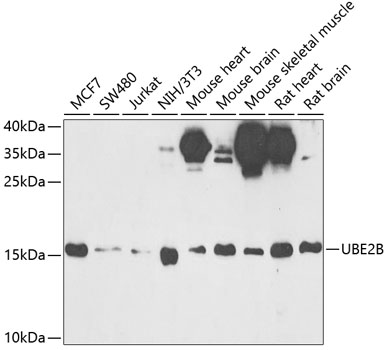
Western blot analysis of various lysates using UBE2B Rabbit pAb (A6315) at 1:1000 dilution. Secondary antibody: HRP-conjugated Goat anti-Rabbit IgG (H+L) (AS014) at 1:10000 dilution. Lysates/proteins: 25µg per lane. Blocking buffer: 3% nonfat dry milk in TBST. Detection: ECL Enhanced Kit (RM00021). Exposure time: 90s. |
Product Guarantee and Expert Support
