

KCNH1 Rabbit pAb, Unconjugated, Polyclonal
Catalog Number:
ABB-A6636
- Images (1)
| Article Name: | KCNH1 Rabbit pAb, Unconjugated, Polyclonal |
| Biozol Catalog Number: | ABB-A6636 |
| Supplier Catalog Number: | A6636 |
| Alternative Catalog Number: | ABB-A6636-100UL,ABB-A6636-20UL,ABB-A6636-500UL,ABB-A6636-1000UL |
| Manufacturer: | ABclonal |
| Host: | Rabbit |
| Category: | Antikörper |
| Application: | ELISA, WB |
| Species Reactivity: | Human |
| Immunogen: | Recombinant protein (or fragment).This information is considered to be commercially sensitive. |
| Conjugation: | Unconjugated |
| Alternative Names: | EAG, EAG1, ZLS1, hEAG, TMBTS, h-eag, hEAG1, Kv10.1, KCNH1 |
| Voltage-gated potassium (Kv) channels represent the most complex class of voltage-gated ion channels from both functional and structural standpoints. Their diverse functions include regulating neurotransmitter release, heart rate, insulin secretion, neuronal excitability, epithelial electrolyte transport, smooth muscle contraction, and cell volume. This gene encodes a member of the potassium channel, voltage-gated, subfamily H. This member is a pore-forming (alpha) subunit of a voltage-gated non-inactivating delayed rectifier potassium channel. It is activated at the onset of myoblast differentiation. The gene is highly expressed in brain and in myoblasts. Overexpression of the gene may confer a growth advantage to cancer cells and favor tumor cell proliferation. Alternative splicing of this gene results in two transcript variants encoding distinct isoforms. |
| Clonality: | Polyclonal |
| Molecular Weight: | 111kDa |
| NCBI: | 3756 |
| UniProt: | O95259 |
| Purity: | Affinity purification |
| Sequence: | FKDACGKSEDWNKVSKAESMETLPERTKASGEATLKKTDSCDSGITKSDLRLDNVGEARSPQDRSPILAEVKHSFYPIPEQTLQATVLEVRHELKEDIKALNAKMTNIEKQLSEILRILTSRRSSQSPQELFEISRPQSPESERDIFGAS |
| Target: | KCNH1 |
| Antibody Type: | Primary Antibody |
| Application Dilute: | WB,1:500 - 1:2000|ELISA,Recommended starting concentration is 1 µg/mL. Please optimize the concentration based on your specific assay requirements. |
| Application Notes: | Cross-Reactivity: Human,Mouse,Rat. ResearchArea: Neuroscience. Shipping: Ice Bag |
|
|
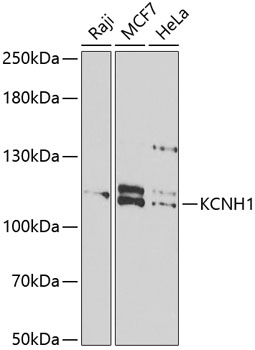
Western blot analysis of various lysates using KCNH1 Rabbit pAb (A6636) at 1:1000 dilution. Secondary antibody: HRP-conjugated Goat anti-Rabbit IgG (H+L) (AS014) at 1:10000 dilution. Lysates/proteins: 25µg per lane. Blocking buffer: 3% nonfat dry milk in TBST. Detection: ECL Basic Kit (RM00020). Exposure time: 90s. |
Product Guarantee and Expert Support
