

PRKD3 Rabbit pAb, Unconjugated, Polyclonal
Catalog Number:
ABB-A7084
- Images (1)
| Article Name: | PRKD3 Rabbit pAb, Unconjugated, Polyclonal |
| Biozol Catalog Number: | ABB-A7084 |
| Supplier Catalog Number: | A7084 |
| Alternative Catalog Number: | ABB-A7084-20UL,ABB-A7084-100UL,ABB-A7084-500UL,ABB-A7084-1000UL |
| Manufacturer: | ABclonal |
| Host: | Rabbit |
| Category: | Antikörper |
| Application: | ELISA, WB |
| Species Reactivity: | Human |
| Immunogen: | Recombinant protein (or fragment).This information is considered to be commercially sensitive. |
| Conjugation: | Unconjugated |
| Alternative Names: | EPK2, PKD3, PRKCN, PKC-NU, nPKC-NU, PRKD3 |
| This gene belongs to the multigene protein kinase D family of serine/threonine kinases, which bind diacylglycerol and phorbol esters. Members of this family are characterized by an N-terminal regulatory domain comprised of a tandem repeat of cysteine-rich zinc-finger motifs and a pleckstrin domain. The C-terminal region contains the catalytic domain and is distantly related to calcium-regulated kinases. Catalytic activity of this enzyme promotes its nuclear localization. This protein has been implicated in a variety of functions including negative regulation of human airway epithelial barrier formation, growth regulation of breast and prostate cancer cells, and vesicle trafficking. |
| Application Dilute: | WB,1:500 - 1:2000|ELISA,Recommended starting concentration is 1 µg/mL. Please optimize the concentration based on your specific assay requirements. |
| Application Notes: | Cross-Reactivity: Human,Mouse. ResearchArea: Signal Transduction,G protein signaling,G-Protein-Coupled Receptors Signaling to MAPK Erk,Kinase,Serine threonine kinases,ErbB-HER Signaling Pathway,MAPK-Erk Signaling Pathway,Cell Biology Developmental Biology,Apoptosis,Mitochondrial Control of Apoptosis,Inhibition of Apoptosis,Immunology Inflammation,B Cell Receptor Signaling Pathway. Shipping: Ice Bag |
|
|
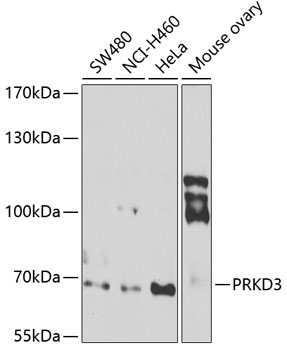
Western blot analysis of various lysates using PRKD3 Rabbit pAb (A7084) at 1:1000 dilution. Secondary antibody: HRP-conjugated Goat anti-Rabbit IgG (H+L) (AS014) at 1:10000 dilution. Lysates/proteins: 25µg per lane. Blocking buffer: 3% nonfat dry milk in TBST. Detection: ECL Basic Kit (RM00020). Exposure time: 90s. |
Product Guarantee and Expert Support
