

COX7A2 Rabbit pAb, Unconjugated, Polyclonal
Catalog Number:
ABB-A8406
- Images (1)
| Article Name: | COX7A2 Rabbit pAb, Unconjugated, Polyclonal |
| Biozol Catalog Number: | ABB-A8406 |
| Supplier Catalog Number: | A8406 |
| Alternative Catalog Number: | ABB-A8406-20UL,ABB-A8406-100UL,ABB-A8406-500UL,ABB-A8406-1000UL |
| Manufacturer: | ABclonal |
| Host: | Rabbit |
| Category: | Antikörper |
| Application: | ELISA, WB |
| Species Reactivity: | Human |
| Immunogen: | Recombinant protein (or fragment).This information is considered to be commercially sensitive. |
| Conjugation: | Unconjugated |
| Alternative Names: | VIIAL, COX7AL, COX7AL1, COXVIIAL, COXVIIa-L, COX7A2 |
| Cytochrome c oxidase, the terminal component of the mitochondrial respiratory chain, catalyzes the electron transfer from reduced cytochrome c to oxygen. This component is a heteromeric complex consisting of three catalytic subunits encoded by mitochondrial genes, and multiple structural subunits encoded by nuclear genes. The mitochondrially-encoded subunits function in electron transfer, while the nuclear-encoded subunits may function in the regulation and assembly of the complex. This nuclear gene encodes polypeptide 2 (liver isoform) of subunit VIIa, with this polypeptide being present in both muscle and non-muscle tissues. In addition to polypeptide 2, subunit VIIa includes polypeptide 1 (muscle isoform), which is present only in muscle tissues, and a related protein, which is present in all tissues. Alternative splicing results in multiple transcript variants. Related pseudogenes have been identified on chromosomes 4 and 14. |
| Application Dilute: | WB,1:500 - 1:2000|ELISA,Recommended starting concentration is 1 µg/mL. Please optimize the concentration based on your specific assay requirements. |
| Application Notes: | Cross-Reactivity: Human. ResearchArea: Signal Transduction,Endocrine Metabolism,Mitochondrial metabolism,Mitochondrial markers,Neuroscience,Neurodegenerative Diseases. Shipping: Ice Bag |
|
|
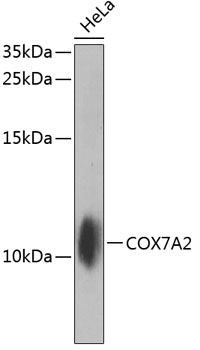
Western blot analysis of lysates from HeLa cells, using COX7A2 Rabbit pAb (A8406) at 1:1000 dilution. Secondary antibody: HRP-conjugated Goat anti-Rabbit IgG (H+L) (AS014) at 1:10000 dilution. Lysates/proteins: 25µg per lane. Blocking buffer: 3% nonfat dry milk in TBST. Detection: ECL Enhanced Kit (RM00021). Exposure time: 10s. |
Product Guarantee and Expert Support
