

BBS10 Rabbit pAb, Unconjugated
Catalog Number:
ABB-A8820
- Images (1)
| Article Name: | BBS10 Rabbit pAb, Unconjugated |
| Biozol Catalog Number: | ABB-A8820 |
| Supplier Catalog Number: | A8820 |
| Alternative Catalog Number: | ABB-A8820-20UL,ABB-A8820-100UL,ABB-A8820-500UL,ABB-A8820-1000UL |
| Manufacturer: | ABclonal |
| Host: | Rabbit |
| Category: | Antikörper |
| Application: | ELISA, WB |
| Species Reactivity: | Human |
| Immunogen: | Recombinant protein (or fragment).This information is considered to be commercially sensitive. |
| Conjugation: | Unconjugated |
| Alternative Names: | C12orf58, BBS10 |
| This gene is a member of the Bardet-Biedl syndrome (BBS) gene family. Bardet-Biedl syndrome is an autosomal recessive disorder characterized by progressive retinal degeneration, obesity, polydactyly, renal malformation and cognitive disability. The proteins encoded by BBS gene family members are structurally diverse and the similar phenotypes exhibited by mutations in BBS gene family members is likely due to their shared roles in cilia formation and function. Many BBS proteins localize to the basal bodies, ciliary axonemes, and pericentriolar regions of cells. BBS proteins may also be involved in intracellular trafficking via microtubule-related transport. The protein encoded by this gene is likely not a ciliary protein but rather has distant sequence homology to type II chaperonins. As a molecular chaperone, this protein may affect the folding or stability of other ciliary or basal body proteins. Inhibition of this proteins expression impairs ciliogenesis in preadipocytes. Mutations in this gene cause Bardet-Biedl syndrome type 10. |
| Clonality: | Polyclonal |
| Molecular Weight: | 81kDa |
| NCBI: | 79738 |
| UniProt: | Q8TAM1 |
| Purity: | Affinity purification |
| Sequence: | AENKDALEKTQTYLKVHSNLVIPDVELETYIPYSTPTLTPTDTFQTVETLTCLSLERNRLTDYYEPLLKNNSTAYSTRGNRIEISYENLQVTNITRKGSMLPVSCKLPNMGTSQSYLSSSMPAGCVLPVGGNFEILLHYYLLNYAKKCHQSEETMVSMIIANALLGIPKVLYKSKTGKYSFPHTYIRAVHALQTNQPLVSSQTGLESVMGKYQLLTSVLQCLTKILTIDMVITVKRHPQKVHNQDSEDEL |
| Target: | BBS10 |
| Antibody Type: | Primary Antibody |
| Application Dilute: | WB,1:200 - 1:3000|ELISA,Recommended starting concentration is 1 µg/mL. Please optimize the concentration based on your specific assay requirements. |
| Application Notes: | Cross-Reactivity: Human,Mouse, ResearchArea: Epigenetics Nuclear Signaling,Transcription Factors,Neuroscience. |
|
|
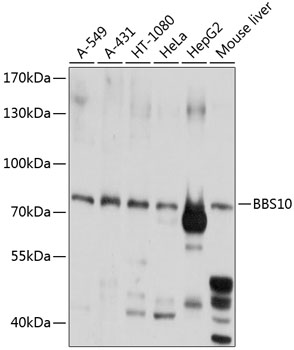
Western blot analysis of various lysates using BBS10 Rabbit pAb (A8820) at 1:1000 dilution. Secondary antibody: HRP-conjugated Goat anti-Rabbit IgG (H+L) (AS014) at 1:10000 dilution. Lysates/proteins: 25µg per lane. Blocking buffer: 3% nonfat dry milk in TBST. Detection: ECL Basic Kit (RM00020). Exposure time: 3s. |
Product Guarantee and Expert Support
