

EPHB2 Rabbit pAb, Unconjugated
Catalog Number:
ABB-A9813
- Images (1)
| Article Name: | EPHB2 Rabbit pAb, Unconjugated |
| Biozol Catalog Number: | ABB-A9813 |
| Supplier Catalog Number: | A9813 |
| Alternative Catalog Number: | ABB-A9813-20UL,ABB-A9813-100UL,ABB-A9813-500UL,ABB-A9813-1000UL |
| Manufacturer: | ABclonal |
| Host: | Rabbit |
| Category: | Antikörper |
| Application: | ELISA, WB |
| Species Reactivity: | Human |
| Immunogen: | Recombinant protein (or fragment).This information is considered to be commercially sensitive. |
| Conjugation: | Unconjugated |
| Alternative Names: | DRT, EK5, ERK, CAPB, Hek5, PCBC, EPHT3, Tyro5, BDPLT22, EPHB2 |
| This gene encodes a member of the Eph receptor family of receptor tyrosine kinase transmembrane glycoproteins. These receptors are composed of an N-terminal glycosylated ligand-binding domain, a transmembrane region and an intracellular kinase domain. They bind ligands called ephrins and are involved in diverse cellular processes including motility, division, and differentiation. A distinguishing characteristic of Eph-ephrin signaling is that both receptors and ligands are competent to transduce a signaling cascade, resulting in bidirectional signaling. This protein belongs to a subgroup of the Eph receptors called EphB. Proteins of this subgroup are distinguished from other members of the family by sequence homology and preferential binding affinity for membrane-bound ephrin-B ligands. Allelic variants are associated with prostate and brain cancer susceptibility. Alternative splicing results in multiple transcript variants. |
| Clonality: | Polyclonal |
| Molecular Weight: | 117kDa |
| NCBI: | 2048 |
| UniProt: | P29323 |
| Purity: | Affinity purification |
| Sequence: | PIGRCMCKAGFEAVENGTVCRGCPSGTFKANQGDEACTHCPINSRTTSEGATNCVCRNGYYRADLDPLDMPCTTIPSAPQAVISSVNETSLMLEWTPPRDSGGREDLVYNIICKSCGSGRGACTRCGDNVQYAPRQLGLTEPRIYISDLLAHTQYTFEIQAVNGVTDQSPFSPQFASVNITTNQAAPSAVSIMHQVSRTVDSITLSWSQPDQPNGVILDYELQYYEKELSEYNATAIKSPTNTVTVQGLKAGAIY |
| Target: | EPHB2 |
| Antibody Type: | Primary Antibody |
| Application Dilute: | WB,1:500 - 1:2000|ELISA,Recommended starting concentration is 1 µg/mL. Please optimize the concentration based on your specific assay requirements. |
| Application Notes: | Cross-Reactivity: Human,Mouse, ResearchArea: Cancer,Signal Transduction,Kinase,Tyrosine kinases,Neuroscience, Cell Type Marker,Cardiovascular,Angiogenesis,Neuron marker. |
|
|
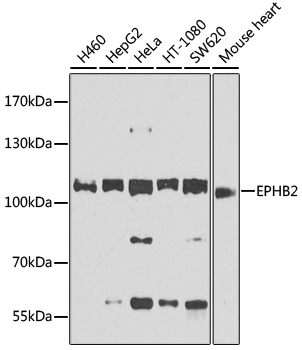
Western blot analysis of various lysates using EPHB2 Rabbit pAb (A9813) at 1:1000 dilution. Secondary antibody: HRP-conjugated Goat anti-Rabbit IgG (H+L) (AS014) at 1:10000 dilution. Lysates/proteins: 25µg per lane. Blocking buffer: 3% nonfat dry milk in TBST. Detection: ECL Basic Kit (RM00020). Exposure time: 30s. |
Product Guarantee and Expert Support
