

KCNJ3 Rabbit pAb, Unconjugated
Catalog Number:
ABB-A9824
- Images (1)
| Article Name: | KCNJ3 Rabbit pAb, Unconjugated |
| Biozol Catalog Number: | ABB-A9824 |
| Supplier Catalog Number: | A9824 |
| Alternative Catalog Number: | ABB-A9824-20UL,ABB-A9824-100UL,ABB-A9824-1000UL,ABB-A9824-500UL |
| Manufacturer: | ABclonal |
| Host: | Rabbit |
| Category: | Antikörper |
| Application: | ELISA, WB |
| Species Reactivity: | Human |
| Immunogen: | Synthetic peptide. This information is considered to be commercially sensitive. |
| Conjugation: | Unconjugated |
| Alternative Names: | KGA, GIRK1, KIR3.1, KCNJ3 |
| Potassium channels are present in most mammalian cells, where they participate in a wide range of physiologic responses. The protein encoded by this gene is an integral membrane protein and inward-rectifier type potassium channel. The encoded protein, which has a greater tendency to allow potassium to flow into a cell rather than out of a cell, is controlled by G-proteins and plays an important role in regulating heartbeat. It associates with three other G-protein-activated potassium channels to form a heteromultimeric pore-forming complex that also couples to neurotransmitter receptors in the brain and whereby channel activation can inhibit action potential firing by hyperpolarizing the plasma membrane. These multimeric G-protein-gated inwardly-rectifying potassium (GIRK) channels may play a role in the pathophysiology of epilepsy, addiction, Downs syndrome, ataxia, and Parkinsons disease. Alternative splicing results in multiple transcript variants encoding distinct proteins. |
| Application Dilute: | WB,1:500 - 1:2000|ELISA,Recommended starting concentration is 1 µg/mL. Please optimize the concentration based on your specific assay requirements. |
| Application Notes: | Cross-Reactivity: Human,Mouse,Rat, ResearchArea: Neuroscience,Cardiovascular,Heart,Cardiac arrhythmias. |
|
|
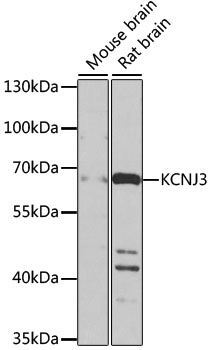
Western blot analysis of various lysates using KCNJ3 Rabbit pAb (A9824) at 1:1000 dilution. Secondary antibody: HRP-conjugated Goat anti-Rabbit IgG (H+L) (AS014) at 1:10000 dilution. Lysates/proteins: 25µg per lane. Blocking buffer: 3% nonfat dry milk in TBST. Detection: ECL Enhanced Kit (RM00021). Exposure time: 10s. |
Product Guarantee and Expert Support
