

CAPN10 Rabbit pAb, Unconjugated
Catalog Number:
ABB-A9865
- Images (1)
| Article Name: | CAPN10 Rabbit pAb, Unconjugated |
| Biozol Catalog Number: | ABB-A9865 |
| Supplier Catalog Number: | A9865 |
| Alternative Catalog Number: | ABB-A9865-20UL,ABB-A9865-100UL,ABB-A9865-1000UL,ABB-A9865-500UL |
| Manufacturer: | ABclonal |
| Host: | Rabbit |
| Category: | Antikörper |
| Application: | ELISA, WB |
| Species Reactivity: | Human |
| Immunogen: | Recombinant protein (or fragment).This information is considered to be commercially sensitive. |
| Conjugation: | Unconjugated |
| Alternative Names: | CANP10, NIDDM1, CAPN10 |
| Calpains represent a ubiquitous, well-conserved family of calcium-dependent cysteine proteases. The calpain proteins are heterodimers consisting of an invariant small subunit and variable large subunits. The large catalytic subunit has four domains: domain I, the N-terminal regulatory domain that is processed upon calpain activation, domain II, the protease domain, domain III, a linker domain of unknown function, and domain IV, the calmodulin-like calcium-binding domain. This gene encodes a large subunit. It is an atypical calpain in that it lacks the calmodulin-like calcium-binding domain and instead has a divergent C-terminal domain. It is similar in organization to calpains 5 and 6. This gene is associated with type 2 or non-insulin-dependent diabetes mellitus (NIDDM), and is located within the NIDDM1 region. Multiple alternative transcript variants have been described for this gene. |
| Clonality: | Polyclonal |
| Molecular Weight: | 75kDa |
| NCBI: | 11132 |
| UniProt: | Q9HC96 |
| Purity: | Affinity purification |
| Sequence: | MRAGRGATPARELFRDAAFPAADSSLFCDLSTPLAQFREDITWRRPQEICATPRLFPDDPREGQVKQGLLGDCWFLCACAALQKSRHLLDQVIPPGQPSWADQEYRGSFTCRIWQFGRWVEVTTDDRLPCLAGRLCFSRCQREDVFWLPLLEKVYAKVHGSYEHLWAGQVADALVDLTGGLAERWNLKGVAGSGGQQDRPGRWEHRTCRQLLHLKDQCLISCCVLSPRAG |
| Target: | CAPN10 |
| Antibody Type: | Primary Antibody |
| Application Dilute: | WB,1:1000 - 1:4000|ELISA,Recommended starting concentration is 1 µg/mL. Please optimize the concentration based on your specific assay requirements. |
| Application Notes: | Cross-Reactivity: Human, ResearchArea: Signal Transduction,Cell Biology Developmental Biology,Ubiquitin,Endocrine Metabolism,Endocrine and metabolic diseases,Neuroscience,Calcium Signaling. |
|
|
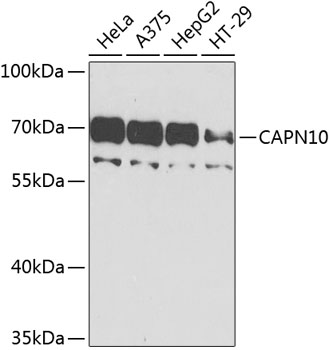
Western blot analysis of various lysates using CAPN10 Rabbit pAb (A9865) at 1:1000 dilution. Secondary antibody: HRP-conjugated Goat anti-Rabbit IgG (H+L) (AS014) at 1:10000 dilution. Lysates/proteins: 25µg per lane. Blocking buffer: 3% nonfat dry milk in TBST. Detection: ECL Basic Kit (RM00020). Exposure time: 90s. |
Product Guarantee and Expert Support
