

MT-ND3 Rabbit pAb, Unconjugated
Catalog Number:
ABB-A9940
- Images (1)
| Article Name: | MT-ND3 Rabbit pAb, Unconjugated |
| Biozol Catalog Number: | ABB-A9940 |
| Supplier Catalog Number: | A9940 |
| Alternative Catalog Number: | ABB-A9940-20UL,ABB-A9940-100UL,ABB-A9940-1000UL,ABB-A9940-500UL |
| Manufacturer: | ABclonal |
| Host: | Rabbit |
| Category: | Antikörper |
| Application: | ELISA, WB |
| Species Reactivity: | Mouse |
| Immunogen: | Synthetic peptide. This information is considered to be commercially sensitive. |
| Conjugation: | Unconjugated |
| Alternative Names: | ND3, MT-ND3 |
| Predicted to enable NADH dehydrogenase (ubiquinone) activity. Predicted to be involved in cellular response to glucocorticoid stimulus, mitochondrial electron transport, NADH to ubiquinone, and response to oxidative stress. Located in mitochondrion. Is expressed in several structures, including alimentary system, brain, genitourinary system, hemolymphoid system gland, and liver and biliary system. Human ortholog(s) of this gene implicated in Leber hereditary optic neuropathy, Leigh disease, and Parkinsons disease. Orthologous to human MT-ND3 (mitochondrially encoded NADH:ubiquinone oxidoreductase core subunit 3). |
| Clonality: | Polyclonal |
| Molecular Weight: | 13kDa |
| NCBI: | 17718 |
| Purity: | Affinity purification |
| Sequence: | MNLYTVIFINILLSLTLILVAFWLPQMNLYSEKANPYECGFDPTSSARLPFSMKFFLVAITFLLFDLEIALLLPLPWAIQTIKTSTMMIMAFILVTILSL |
| Target: | mt-Nd3 |
| Antibody Type: | Primary Antibody |
| Application Dilute: | WB,1:500 - 1:2000|ELISA,Recommended starting concentration is 1 µg/mL. Please optimize the concentration based on your specific assay requirements. |
| Application Notes: | Cross-Reactivity: Human,Mouse,Rat, ResearchArea: Signal Transduction,Endocrine & Metabolism,Mitochondrial metabolism,Neuroscience,Neurodegenerative Diseases. |
|
|
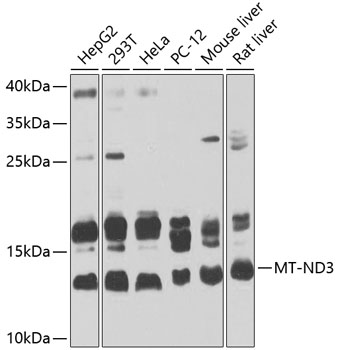
Western blot analysis of various lysates using MT-ND3 Rabbit pAb (A9940) at 1:1000 dilution. Secondary antibody: HRP-conjugated Goat anti-Rabbit IgG (H+L) (AS014) at 1:10000 dilution. Lysates/proteins: 25µg per lane. Blocking buffer: 3% nonfat dry milk in TBST. Detection: ECL Basic Kit (RM00020). Exposure time: 30s. |
Product Guarantee and Expert Support
