

Phospho-GRIN2B-Y1474 Rabbit pAb, Unconjugated
Catalog Number:
ABB-AP0357
- Images (1)
| Article Name: | Phospho-GRIN2B-Y1474 Rabbit pAb, Unconjugated |
| Biozol Catalog Number: | ABB-AP0357 |
| Supplier Catalog Number: | AP0357 |
| Alternative Catalog Number: | ABB-AP0357-20UL, ABB-AP0357-100UL |
| Manufacturer: | ABclonal |
| Host: | Rabbit |
| Category: | Antikörper |
| Application: | ELISA, WB |
| Species Reactivity: | Human |
| Immunogen: | Synthetic peptide. This information is considered to be commercially sensitive. |
| Conjugation: | Unconjugated |
| Alternative Names: | NR3, MRD6, NR2B, hNR3, DEE27, EIEE27, GluN2B, NMDAR2B, Phospho-GRIN2B-Y1474 |
| This gene encodes a member of the N-methyl-D-aspartate (NMDA) receptor family within the ionotropic glutamate receptor superfamily. The encoded protein is a subunit of the NMDA receptor ion channel which acts as an agonist binding site for glutamate. The NMDA receptors mediate a slow calcium-permeable component of excitatory synaptic transmission in the central nervous system. The NMDA receptors are heterotetramers of seven genetically encoded, differentially expressed subunits including NR1 (GRIN1), NR2 (GRIN2A, GRIN2B, GRIN2C, or GRIN2D) and NR3 (GRIN3A or GRIN3B). The early expression of this gene in development suggests a role in brain development, circuit formation, synaptic plasticity, and cellular migration and differentiation. Naturally occurring mutations within this gene are associated with neurodevelopmental disorders including autism spectrum disorder, attention deficit hyperactivity disorder, epilepsy, and schizophrenia. |
| Application Dilute: | WB,1:500 - 1:2000|ELISA,Recommended starting concentration is 1 µg/mL. Please optimize the concentration based on your specific assay requirements. |
| Application Notes: | Cross-Reactivity: Human, ResearchArea: Protein phosphorylation,Neuroscience,Neurodegenerative Diseases,Amyloid Plaque and Neurofibrillary Tangle Formation in Alzheimers Disease,Dopamine Signaling in Parkinsons Disease. |
|
|
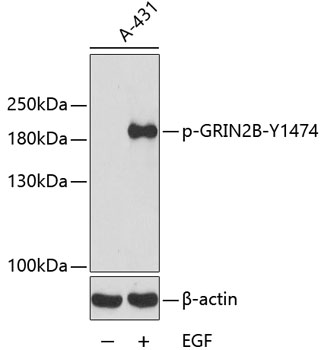
Western blot analysis of lysates from A431 cells, using Phospho-GRIN2B-Y1474 Rabbit pAb (AP0357). Secondary antibody: HRP-conjugated Goat anti-Rabbit IgG (H+L) (AS014) at 1:10000 dilution. Lysates/proteins: 25µg per lane. Blocking buffer: 3% BSA. |
Product Guarantee and Expert Support
