

Phospho-SHIP1-Y1020 Rabbit pAb, Unconjugated
Catalog Number:
ABB-AP0778
- Images (1)
| Article Name: | Phospho-SHIP1-Y1020 Rabbit pAb, Unconjugated |
| Biozol Catalog Number: | ABB-AP0778 |
| Supplier Catalog Number: | AP0778 |
| Alternative Catalog Number: | ABB-AP0778-20UL, ABB-AP0778-100UL |
| Manufacturer: | ABclonal |
| Host: | Rabbit |
| Category: | Antikörper |
| Application: | ELISA, WB |
| Species Reactivity: | Human |
| Immunogen: | Synthetic peptide. This information is considered to be commercially sensitive. |
| Conjugation: | Unconjugated |
| Alternative Names: | SHIP, SHIP1, SHIP-1, hp51CN, SIP-145, p150Ship, Phospho-SHIP1-Y1020 |
| This gene is a member of the inositol polyphosphate-5-phosphatase (INPP5) family and encodes a protein with an N-terminal SH2 domain, an inositol phosphatase domain, and two C-terminal protein interaction domains. Expression of this protein is restricted to hematopoietic cells where its movement from the cytosol to the plasma membrane is mediated by tyrosine phosphorylation. At the plasma membrane, the protein hydrolyzes the 5 phosphate from phosphatidylinositol (3,4,5)-trisphosphate and inositol-1,3,4,5-tetrakisphosphate, thereby affecting multiple signaling pathways. The protein is also partly localized to the nucleus, where it may be involved in nuclear inositol phosphate signaling processes. Overall, the protein functions as a negative regulator of myeloid cell proliferation and survival. Mutations in this gene are associated with defects and cancers of the immune system. Deficiencies in the encoded protein, SHIP1, have been associated with Inflammatory Bowel Disease types such as Crohns Disease and Ulcerative Colitis. Alternative splicing of this gene results in multiple transcript variants. |
| Application Dilute: | WB,1:500 - 1:1000|ELISA,Recommended starting concentration is 1 µg/mL. Please optimize the concentration based on your specific assay requirements. |
| Application Notes: | Cross-Reactivity: Human, ResearchArea: Epigenetics Nuclear Signaling,Protein phosphorylation,Signal Transduction,Cell Biology Developmental Biology,Apoptosis,Endocrine Metabolism,Lipid Metabolism,Insulin Receptor Signaling Pathway,Immunology Inflammation,B Cell Receptor Signaling Pathway. |
|
|
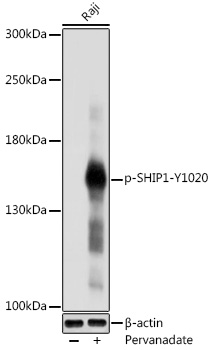
Western blot analysis of lysates from Raji cells, using Phospho-SHIP1-Y1020 Rabbit pAb (AP0778) at 1:1000 dilution. Raji cells were treated with Pervanadate (1 mM) at 37°C for 30 minutes. Secondary antibody: HRP-conjugated Goat anti-Rabbit IgG (H+L) (AS014) at 1:10000 dilution. Lysates/proteins: 25µg per lane. Blocking buffer: 3% nonfat dry milk in TBST. Detection: ECL Basic Kit (RM00020). Exposure time: 1s. |
Product Guarantee and Expert Support
