

Phospho-Cdk1/2-T14 Rabbit mAb, Unconjugated
Catalog Number:
ABB-AP1001
- Images (1)
| Article Name: | Phospho-Cdk1/2-T14 Rabbit mAb, Unconjugated |
| Biozol Catalog Number: | ABB-AP1001 |
| Supplier Catalog Number: | AP1001 |
| Alternative Catalog Number: | ABB-AP1001-100UL,ABB-AP1001-20UL,ABB-AP1001-500UL,ABB-AP1001-1000UL |
| Manufacturer: | ABclonal |
| Host: | Rabbit |
| Category: | Antikörper |
| Application: | ELISA, WB |
| Species Reactivity: | Human |
| Immunogen: | Synthetic peptide. This information is considered to be commercially sensitive. |
| Conjugation: | Unconjugated |
| Alternative Names: | CDC2, CDC28A, P34CDC2, Phospho-Cdk1/2-T14 |
| The protein encoded by this gene is a member of the Ser/Thr protein kinase family. This protein is a catalytic subunit of the highly conserved protein kinase complex known as M-phase promoting factor (MPF), which is essential for G1/S and G2/M phase transitions of eukaryotic cell cycle. Mitotic cyclins stably associate with this protein and function as regulatory subunits. The kinase activity of this protein is controlled by cyclin accumulation and destruction through the cell cycle. The phosphorylation and dephosphorylation of this protein also play important regulatory roles in cell cycle control. Alternatively spliced transcript variants encoding different isoforms have been found for this gene. [provided by RefSeq, Mar 2009] |
| Application Dilute: | WB,1:500 - 1:1000|ELISA,Recommended starting concentration is 1 µg/mL. Please optimize the concentration based on your specific assay requirements. |
| Application Notes: | Cross-Reactivity: Human,Mouse,Rat, ResearchArea: Cell Biology Cell Cycle Kinases/Phosphatases CdksNeuroscience Neurology process Neural Signal TransductionNeuroscience Neurology process Neurodegenerative disease OtherEpigenetics and Nuclear Signaling Cell cycle Kinases/Phosphatases CdksCancer Cell cycle Kinases/phosphatases Cdks. |
|
|
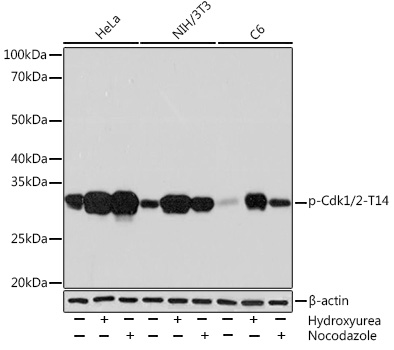
Western blot analysis of various lysates using Phospho-Cdk1/2-T14 Rabbit mAb (AP1001) at 1:1000 dilution. HeLa cells and NIH/3T3 cells and C6 cells were treated with Hydroxyurea (4 Mm) at 37°C for 20 hours or treated with Nocodazole (100 ng/mL) at 37°C for 24 hours. Secondary antibody: HRP-conjugated Goat anti-Rabbit IgG (H+L) (AS014) at 1:10000 dilution. Lysates/proteins: 25µg per lane. Blocking buffer: 3% BSA. Detection: ECL Basic Kit (RM00020). Exposure time: 30s. |
Product Guarantee and Expert Support
