

Phospho-RPA2-T21 Rabbit mAb, Unconjugated
Catalog Number:
ABB-AP1040
- Images (1)
| Article Name: | Phospho-RPA2-T21 Rabbit mAb, Unconjugated |
| Biozol Catalog Number: | ABB-AP1040 |
| Supplier Catalog Number: | AP1040 |
| Alternative Catalog Number: | ABB-AP1040-100UL,ABB-AP1040-20UL,ABB-AP1040-1000UL,ABB-AP1040-500UL |
| Manufacturer: | ABclonal |
| Host: | Rabbit |
| Category: | Antikörper |
| Application: | ELISA, WB |
| Species Reactivity: | Human |
| Immunogen: | Synthetic peptide. This information is considered to be commercially sensitive. |
| Conjugation: | Unconjugated |
| Alternative Names: | REPA2, RPA32, RP-A p32, RP-A p34, Phospho-RPA2-T21 |
| This gene encodes a subunit of the heterotrimeric Replication Protein A (RPA) complex, which binds to single-stranded DNA (ssDNA), forming a nucleoprotein complex that plays an important role in DNA metabolism, being involved in DNA replication, repair, recombination, telomere maintenance, and co-ordinating the cellular response to DNA damage through activation of the ataxia telangiectasia and Rad3-related protein (ATR) kinase. The RPA complex protects single-stranded DNA from nucleases, prevents formation of secondary structures that would interfere with repair, and co-ordinates the recruitment and departure of different genome maintenance factors. The heterotrimeric complex has two different modes of ssDNA binding, a low-affinity and high-affinity mode, determined by which oligonucleotide/oligosaccharide-binding (OB) domains of the complex are utilized, and differing in the length of DNA bound. This subunit contains a single OB domain that participates in high-affinity DNA binding and also contains a winged helix domain at its carboxy terminus, which interacts with many genome maintenance protein. Post-translational modifications of the RPA complex also plays a role in co-ordinating different damage response pathways. |
| Application Dilute: | WB,1:500 - 1:1000|ELISA,Recommended starting concentration is 1 µg/mL. Please optimize the concentration based on your specific assay requirements. |
| Application Notes: | Cross-Reactivity: Human,Rat, ResearchArea: Epigenetics Nuclear Signaling,DNA Damage Repair. |
|
|
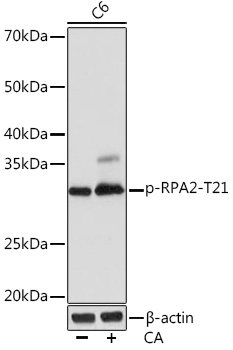
Western blot analysis of lysates from C6 cells, using Phospho-RPA2-T21 Rabbit mAb (AP1040) at 1:1000 dilution. C6 cells were treated with Calyculin A (100 nM) at 37°C for 30 minutes after serum-starvation overnight. Secondary antibody: HRP-conjugated Goat anti-Rabbit IgG (H+L) (AS014) at 1:10000 dilution. Lysates/proteins: 25µg per lane. Blocking buffer: 3% BSA. Detection: ECL Basic Kit (RM00020). Exposure time: 10s. |
Product Guarantee and Expert Support
