

Phospho-MAP2K3-S189 + MAP2K6-S207 Rabbit pAb
Catalog Number:
ABB-AP1112
- Images (1)
| Article Name: | Phospho-MAP2K3-S189 + MAP2K6-S207 Rabbit pAb |
| Biozol Catalog Number: | ABB-AP1112 |
| Supplier Catalog Number: | AP1112 |
| Alternative Catalog Number: | ABB-AP1112-20UL, ABB-AP1112-100UL |
| Manufacturer: | ABclonal |
| Host: | Rabbit |
| Category: | Antikörper |
| Application: | ELISA, WB |
| Species Reactivity: | Human |
| Immunogen: | Synthetic peptide. This information is considered to be commercially sensitive. |
| Alternative Names: | MEK3, MKK3, MAPKK3, PRKMK3, SAPKK2, SAPKK-2 |
| The protein encoded by this gene is a dual specificity protein kinase that belongs to the MAP kinase kinase family. This kinase is activated by mitogenic and environmental stress, and participates in the MAP kinase-mediated signaling cascade. It phosphorylates and thus activates MAPK14/p38-MAPK. This kinase can be activated by insulin, and is necessary for the expression of glucose transporter. Expression of RAS oncogene is found to result in the accumulation of the active form of this kinase, which thus leads to the constitutive activation of MAPK14, and confers oncogenic transformation of primary cells. The inhibition of this kinase is involved in the pathogenesis of Yersina pseudotuberculosis. Multiple alternatively spliced transcript variants that encode distinct isoforms have been reported for this gene. [provided by RefSeq, Jul 2008] |
| Application Dilute: | WB,1:500 - 1:1000|ELISA,Recommended starting concentration is 1 µg/mL. Please optimize the concentration based on your specific assay requirements. |
| Application Notes: | Cross-Reactivity: Human,Mouse, ResearchArea: Signal Transduction Protein Phosphorylation Ser / Thr Kinases MAPK PathwayCancer Signal transduction Protein phosphorylation Serine/threonine kinases MAPK pathway |
|
|
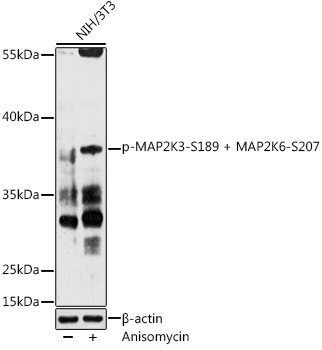
Western blot analysis of lysates from NIH/3T3 cells, using Phospho-MAP2K3-S189 + MAP2K6-S207 Rabbit pAb (AP1112) at 1:1000 dilution. NIH/3T3 cells were treated with Anisomycin (25 µg/mL) at 37°C for 30 minutes after serum-starvation overnight. Secondary antibody: HRP-conjugated Goat anti-Rabbit IgG (H+L) (AS014) at 1:10000 dilution. Lysates/proteins: 25µg per lane. Blocking buffer: 3% nonfat dry milk in TBST. Detection: ECL Basic Kit (RM00020). Exposure time: 180s. |
Product Guarantee and Expert Support
